What Is Clean Beauty? Your 2026 Skincare Guide
What Is Clean Beauty? Your 2026 Skincare Guide
TL;DR:
- Clean beauty involves choosing personal care products free from ingredients linked to health or environmental harm, emphasizing transparency and ethical sourcing.
- Consumers should scrutinize ingredient lists and seek third-party certifications like EWG Verified or MADE SAFE to ensure product safety despite the lack of legal standards.
Clean beauty is defined as personal care and cosmetic products formulated without ingredients considered potentially harmful, with a focus on ingredient transparency, ethical sourcing, and consumer wellness. The term has grown from a niche concern into a mainstream skincare category, but it carries no standardized legal definition in the United States. That gap matters. Understanding what clean beauty actually means, versus what brands claim it means, is the difference between making informed choices and falling for marketing. This guide breaks down the clean beauty definition, what ingredients to watch for, and how to shop smarter in 2026.
What is clean beauty and how is it defined?
Clean beauty is the practice of choosing personal care products made without ingredients linked to potential health or environmental harm, while prioritizing full ingredient disclosure. As Healthline notes, clean beauty is a growing movement with no government-controlled standard for the term. That means every brand sets its own rules. One company’s “clean” may allow ingredients another brand explicitly bans.
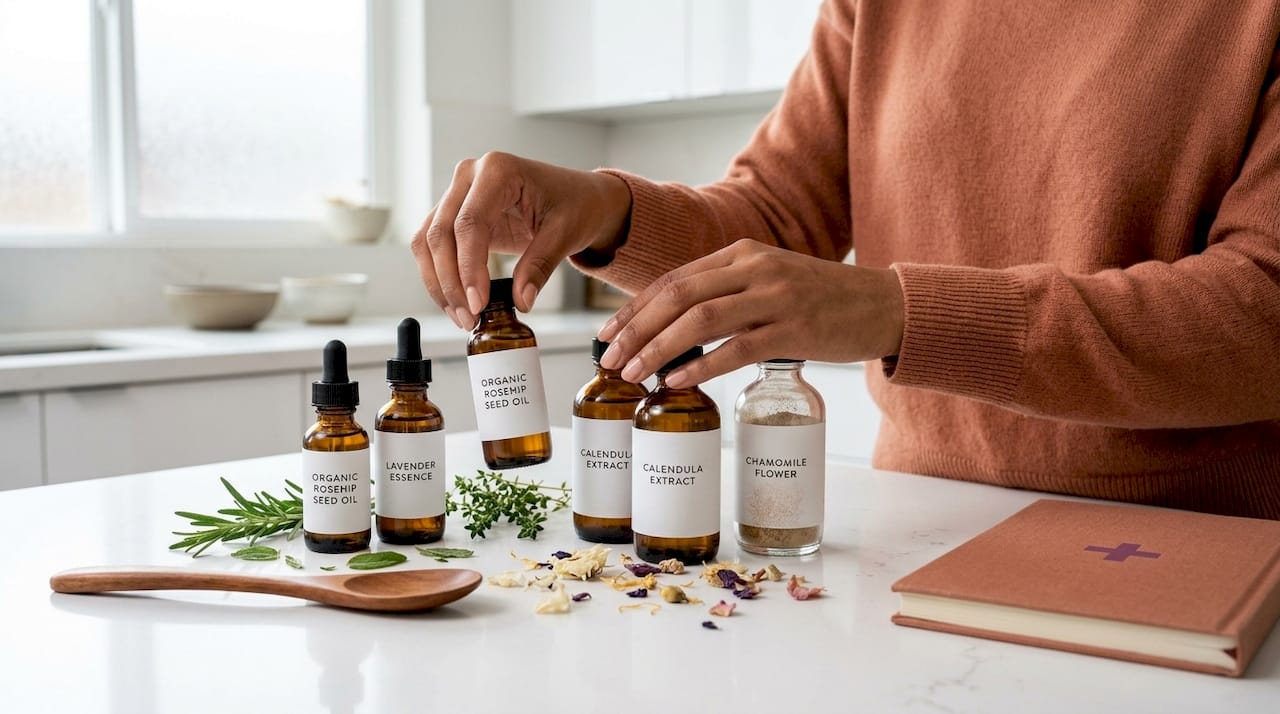
The movement draws on broader wellness values: reduced chemical exposure, sustainable sourcing, and cruelty-free production. Organizations like the Environmental Working Group (EWG) and certification bodies like MADE SAFE have stepped in to fill the regulatory gap, creating their own ingredient standards. These third-party frameworks give the term more structure than federal law currently provides. For consumers, ingredient lists are more reliable for assessing product safety than any brand’s “clean” claim.
What ingredients are avoided in clean beauty products?
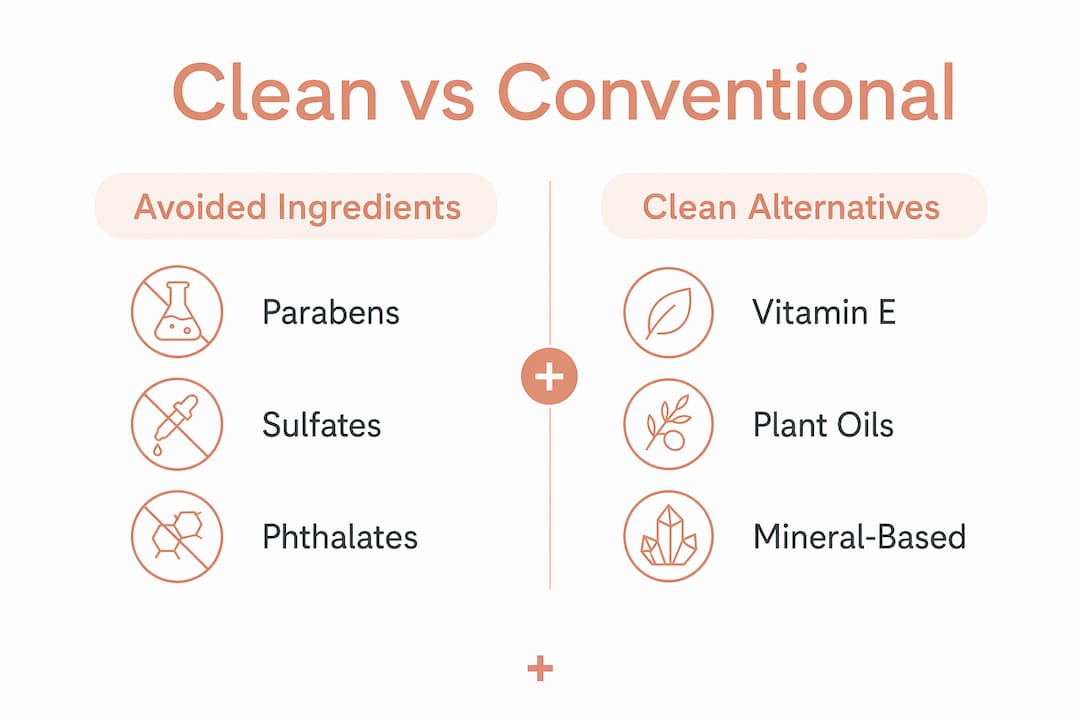
Clean beauty products typically exclude a defined set of ingredients associated with hormone disruption, skin irritation, or environmental damage. The most commonly avoided include parabens, sulfates, phthalates, formaldehyde-releasing preservatives, and oxybenzone. Each of these has been flagged in peer-reviewed research or regulatory reviews for potential health concerns, though the level of risk varies by ingredient and exposure level.
| Conventional Ingredient | Clean Alternative |
|---|---|
| Parabens (methylparaben, propylparaben) | Vitamin E, rosemary extract |
| Sodium lauryl sulfate (SLS) | Coco-glucoside, decyl glucoside |
| Synthetic fragrance (undisclosed) | Essential oils, botanical extracts |
| Oxybenzone (chemical sunscreen) | Zinc oxide, titanium dioxide |
| Formaldehyde-releasing preservatives | Benzyl alcohol, salicylic acid |
Fragrance disclosure is one of the most significant gaps in clean beauty standards. Fragrance components are often listed simply as “fragrance” on labels, masking dozens of undisclosed chemicals. This single loophole can undermine an otherwise clean formulation. Brands that disclose every fragrance component individually are operating at a higher transparency standard than most.
The natural versus synthetic debate adds another layer. Not every synthetic ingredient is harmful, and not every natural one is safe. Poison ivy is natural. Niacinamide is synthetic. The distinction that matters is whether an ingredient poses a risk at the concentrations used in a product.
Pro Tip: When reading a label, search the EWG Skin Deep database for any ingredient you don’t recognize. It rates ingredients by hazard level and flags known concerns, giving you a faster read than decoding scientific names alone.
How does clean beauty differ from natural and conventional products?
Clean beauty, natural beauty, and conventional beauty are three distinct categories that consumers frequently conflate. The differences are meaningful and affect both formulation and safety claims.
- Conventional beauty: No ingredient restrictions beyond what federal law prohibits. The FDA bans or restricts only 11 cosmetic ingredients in the U.S., compared to over 1,300 in the European Union.
- Natural beauty: Products formulated primarily with plant-derived or mineral ingredients. Natural does not mean free from allergens, irritants, or harmful compounds. A 2019 JAMA commentary highlighted that natural ingredients are not inherently safer than synthetic ones. Safety depends on chemical properties and dose.
- Clean beauty: Focuses on excluding specific ingredients considered potentially harmful, regardless of whether the remaining ingredients are natural or synthetic. A clean product may contain lab-synthesized ingredients that are well-studied and low-risk.
The marketing-driven nature of “clean” claims is the core issue. Because no federal agency defines the term, brands can self-certify without independent verification. A product labeled “clean” may still contain synthetic fragrance, undisclosed contaminants, or ingredients that other clean brands explicitly avoid. This is why ethical sourcing practices and third-party certifications carry more weight than label language alone.
What does the law say about clean beauty claims?
The legal framework around clean beauty is thin, and that creates real risk for both consumers and brands. The FDA does not define “clean beauty,” and neither the FDA nor the FTC formally defines terms like “non-toxic” or “clean” under federal cosmetic law. A brand can print either word on packaging without meeting any standardized criteria.
The FTC does provide some guardrails. Under the FTC Green Guides, 16 CFR 260.10, non-toxic claims must be substantiated by competent scientific evidence or they qualify as deceptive advertising. That standard is harder to meet than most brands acknowledge. A product claiming to be “non-toxic” without published safety data is legally exposed.
Here are the key legal points every clean beauty consumer should understand:
- “Clean,” “non-toxic,” and “natural” are unregulated marketing terms in the U.S. No federal agency enforces a definition.
- The FTC can pursue brands for deceptive environmental or safety claims if they lack scientific substantiation.
- Third-party certifications from EWG Verified or MADE SAFE provide independent evaluation that brand marketing does not.
- Class action lawsuits have targeted cosmetic brands for misleading “clean” or “natural” claims, particularly when products contained synthetic or potentially harmful ingredients.
- The EU Cosmetics Regulation bans over 1,300 ingredients that remain legal in U.S. products, creating a significant safety gap for American consumers.
Pro Tip: Look for EWG Verified or MADE SAFE seals on products. These certifications require brands to disclose and substantiate ingredient safety, going well beyond what U.S. law requires.
How to choose clean beauty products that work for you
Choosing clean beauty skincare effectively means going beyond the label and focusing on specific ingredients relevant to your skin type and health concerns. Broad reliance on the word “clean” is not enough. Avoiding specific risky ingredients produces measurable reductions in chemical exposure. A Columbia University study found that switching to products without oxybenzone lowered its presence in participants’ urine samples. That is a concrete, documented benefit tied to ingredient-specific choices, not brand claims.
Accessibility matters too. Clean beauty products have historically skewed toward premium price points, which creates barriers for many consumers. Fortunately, brands across price ranges now offer cleaner formulations. Checking ingredient lists directly, rather than relying on marketing language, levels the playing field regardless of budget.
Best practices for clean beauty shopping:
- Read the full ingredient list, not just the front label claims.
- Use the EWG Skin Deep database or the Think Dirty app to check specific ingredients.
- Prioritize avoiding ingredients that conflict with your personal health concerns or known sensitivities.
- Look for third-party certifications: EWG Verified, MADE SAFE, Leaping Bunny, or COSMOS Organic.
- Be skeptical of “free from” claims without a full ingredient disclosure. Knowing what is absent is less useful than knowing what is present.
- Consider switching to an organic routine gradually, starting with products that stay on skin longest, like moisturizers and serums.
Pro Tip: Rinse-off products like cleansers and shampoos carry lower exposure risk than leave-on products. If budget limits your clean beauty choices, prioritize leave-on products like serums, moisturizers, and sunscreens first.
What are the real benefits and limitations of clean beauty?
The benefits of clean beauty are real but require honest framing. On the positive side, the movement has pushed brands toward greater ingredient transparency, reduced use of known irritants and endocrine disruptors, and increased attention to environmental and ethical production standards. Consumer demand for cleaner formulations has driven reformulation across major brands, including Sephora’s Clean at Sephora program and Target’s cleaner standards initiative.
The limitations are equally real. Clean beauty claims vary widely by brand, and research on universal benefits is limited because there is no standard definition to study. A product meeting one brand’s clean criteria may fail another’s. Fragrance disclosure gaps, contaminant risks from natural ingredients, and the absence of federal oversight all reduce the reliability of “clean” as a safety signal on its own.
Clean beauty operates more as a consumer empowerment framework than a regulated safety standard. That framing is useful. It places responsibility on consumers to develop ingredient literacy rather than trusting labels. The movement’s greatest contribution may be cultural: it has normalized the expectation that brands should disclose what is in their products and why.
Key takeaways
Clean beauty is most effective as a framework for ingredient scrutiny, not a guarantee of safety, and its value depends entirely on the consumer’s ability to read and evaluate ingredient lists independently.
| Point | Details |
|---|---|
| No legal definition exists | “Clean beauty” is unregulated in the U.S.; every brand sets its own ingredient standards. |
| Ingredient lists beat label claims | Reading the full INCI list is more reliable than trusting front-of-pack marketing language. |
| Third-party certifications matter | EWG Verified and MADE SAFE provide independent verification that brand claims do not. |
| Natural does not mean safer | Safety depends on chemical properties and dose, not whether an ingredient is plant-derived. |
| Specific avoidance reduces exposure | Targeting known risky ingredients like oxybenzone produces measurable health benefits. |
Why ingredient literacy matters more than the “clean” label
I have spent enough time reading skincare research to know that the word “clean” on a label tells you almost nothing on its own. What it signals is intent. Whether that intent is backed by real formulation standards is a separate question entirely, and one that requires you to look past the packaging.
The most useful shift I have seen in this space is consumers moving from label trust to ingredient literacy. When you know that “fragrance” can mask dozens of undisclosed compounds, or that a product can be marketed as clean while still containing synthetic fragrance, you stop relying on the front of the bottle. You go straight to the ingredient list. That habit protects you regardless of what any brand claims.
My honest view is that the clean beauty movement has done more good than harm, but it needs stronger regulatory backing to reach its potential. The EU’s approach, banning over 1,300 ingredients versus the U.S.'s 11, shows what is possible when governments treat cosmetic safety seriously. Until U.S. law catches up, ingredient literacy and third-party certifications are the most reliable tools available. A green skincare routine built on verified ingredients will always outperform one built on marketing language.
— Kelly
Yukaface: clean, vegan skincare with full transparency
Yukaface builds every product around the principles that define clean beauty skincare: no harmful additives, full ingredient transparency, and formulations that work for all skin types and ages.
The Yukaface vegan skincare guide covers ingredient standards, formulation philosophy, and how to build a routine that supports your skin without compromise. For those focused on hydration and skin restoration, the hydration and restoration guide outlines how clean, botanically sourced ingredients support lasting skin health. Yukaface products are vegan, cruelty-free, and created with the same ingredient scrutiny this article recommends. Explore the full range at yukaface.com.
FAQ
What is the clean beauty definition in simple terms?
Clean beauty refers to personal care products formulated without ingredients considered potentially harmful, with a focus on ingredient transparency and consumer safety. The term has no standardized legal definition in the U.S., so standards vary by brand.
Is clean beauty actually effective for skincare?
Clean beauty products can be effective, but effectiveness depends on formulation quality rather than the “clean” label itself. Research is limited due to the lack of a universal standard, so evaluating specific ingredients remains the most reliable approach.
What ingredients does clean beauty avoid?
Clean beauty products typically avoid parabens, sulfates, phthalates, formaldehyde-releasing preservatives, oxybenzone, and undisclosed synthetic fragrance. The specific exclusion list varies by brand and certification body.
How is clean beauty different from natural beauty?
Clean beauty focuses on excluding potentially harmful ingredients regardless of their origin, while natural beauty prioritizes plant-derived or mineral ingredients. A natural ingredient is not automatically safe, and a synthetic ingredient is not automatically harmful.
What certifications should I look for in clean beauty products?
EWG Verified and MADE SAFE are the most recognized independent certifications for clean beauty products in the U.S. Both require brands to substantiate ingredient safety beyond what federal law mandates.