
What is a green skincare routine? Steps for healthier skin
The words “green,” “clean,” and “natural” are everywhere in skincare right now. They appear on packaging, in ads, and across social media feeds. Most people assume these labels signal something safe, ethical, and eco-friendly. The reality is more complicated. Without standardized definitions or regulatory oversight, these terms can mean almost anything a brand wants them to mean. Understanding what a green skincare routine actually involves, beyond the marketing, gives you the tools to make better decisions for your skin and the planet.
Demystifying ‘green’ skincare: What it really means
The term “green skincare routine” gets used loosely. In practice, a green skincare routine generally means choosing products for lower environmental and ethical impact while still meeting core skin health needs like cleansing, moisturizing, and sun protection. That is the functional definition. What it does not mean is that every product labeled “green” actually delivers on that promise.
The core problem is regulation, or the lack of it. Green and clean labeling in cosmetics is not a standardized regulatory definition. Brands can call a product “natural,” “clean,” or “eco-friendly” without meeting any specific standard. That makes these terms marketing descriptors first and factual claims second.
“Natural, clean, green, and chemical-free are not regulated terms in cosmetics. Without third-party certification or specific, verifiable claims, treat them as marketing language.”
What actually signals a genuine green commitment? Look for these:
Third-party certifications. Labels like COSMOS Organic, USDA Organic, Leaping Bunny, or EWG Verified carry specific, audited standards.
Ingredient transparency. Full ingredient lists (INCI format), sourcing details, and safety data are signs of a credible brand.
Cruelty-free status. Confirmed no animal testing, at any stage of production or supply chain.
Vegan formulas. No animal-derived ingredients like beeswax, lanolin, or carmine.
Responsible packaging. Recyclable, refillable, or minimal packaging materials.
For a deeper look at what vegan skincare really involves, the vegan skincare guide from Yuka+Face breaks down ingredients, certifications, and common misconceptions. It is a useful starting point for anyone building a values-aligned routine.
Core steps of an effective green skincare routine
A green routine does not require reinventing your entire bathroom cabinet overnight. It means applying evidence-based skin fundamentals while choosing products that align with lower-impact values. The non-negotiables are cleansing, antioxidant support, barrier repair, and broad-spectrum sun protection.
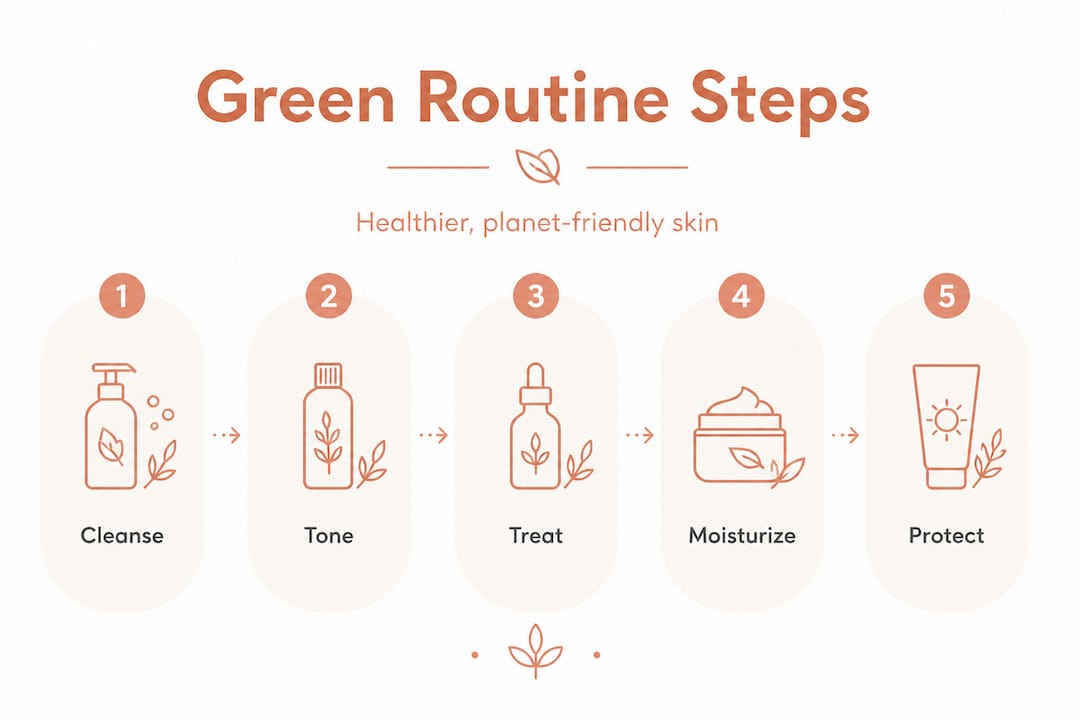
Here are the core steps, in order:
Cleanse. Remove pollutants, makeup, sunscreen, and excess sebum. Choose a gentle, sulfate-free formula. Look for plant-derived surfactants and biodegradable formulas.
Treat. Apply leave-on antioxidants or targeted actives. Green tea extract is one of the most well-researched botanical antioxidants, offering protection against oxidative stress and environmental damage.
Moisturize. Repair and reinforce the skin barrier. Choose formulas with ingredients like ceramides, squalane (plant-derived), or hyaluronic acid. Packaging matters here too: opt for airless pumps or glass jars with tight seals to reduce contamination and waste.
Protect. Apply broad-spectrum SPF every morning. This step is non-negotiable for skin health, regardless of your green priorities.
Routine stepConventional optionGreen-aligned optionCleanseFoaming cleanser with SLSGentle, plant-surfactant cleanserTreatSynthetic antioxidant serumBotanical vitamin C or green tea serumMoisturizePetrolatum-based creamPlant-based squalane or ceramide moisturizerProtectChemical SPF with oxybenzoneMineral SPF with zinc oxide
Pro Tip: Read the ingredient list from top to bottom. Ingredients are listed in descending order of concentration. If a key “green” ingredient appears near the bottom, after preservatives and fragrance, it is present in trace amounts only.
For those looking at how green routines adapt across life stages, the modern ageless skincare guide covers how skin needs shift with age and how botanical formulas can support those changes effectively.
Greenwashing and how to avoid it
Greenwashing is what happens when a brand uses sustainability language to appeal to conscious consumers without the substance to back it up. It is common, often unintentional on the surface, and very easy to fall for. The market pressure to appear “clean” is high, and the lack of regulatory definitions makes it easy for brands to use broad claims without accountability.
Greenwashing risk increases significantly when brands rely on undefined terms like “clean,” “green,” “natural,” or “chemical-free” without concrete standards. Third-party certifications and specific, verifiable ingredient claims are far more reliable than buzzwords on packaging.
Watch for these common greenwashing tactics:
Vague environmental claims. “Eco-friendly,” “earth-conscious,” or “planet-safe” without any supporting data.
Single-ingredient focus. Highlighting one botanical ingredient to imply the whole formula is natural.
Irrelevant claims. “Paraben-free” when parabens were never standard in that product category anyway.
Misleading imagery. Green leaves, earthy tones, and nature photography that imply natural formulation.
Selective certification. Certified organic for one ingredient, but no certification for the full product.
Pro Tip: Search for a product’s full INCI ingredient list on third-party databases like EWG’s Skin Deep or the INCI Decoder before purchasing. These tools flag synthetic additives, potential irritants, and environmental concerns that packaging rarely mentions.
Packaging transparency is another area where brands can obscure impact. A bottle made with 10% recycled plastic is not meaningfully sustainable, but it may be marketed as such. Yuka+Face’s approach to sustainable packaging outlines what responsible packaging decisions actually look like in practice, covering materials, end-of-life options, and the questions worth asking.
Callout: Roughly 42% of green claims made online have been found to be exaggerated, false, or deceptive, according to European Commission research. That figure puts the scale of greenwashing into perspective. It is not a fringe problem. It is standard practice across many product categories, including beauty and skincare.
Balancing skin health with sustainability and ethics
Here is where it gets practical. Skin health and environmental ethics do not always point in the same direction. Some highly effective clinical actives are synthetic. Some truly sustainable packaging formats are less convenient. Some certified organic formulas are not right for sensitive or acne-prone skin. The goal is not perfection. It is informed balance.
The most useful framework separates skin health mechanics from sustainability checks. Barrier function, cleansing efficacy, SPF protection, and targeted actives belong in the first category. Certifications, packaging end-of-life, ingredient sourcing, and ethical manufacturing belong in the second. Evaluate each independently, then find products that score well on both.
“Start with what your skin needs. Then layer in your ethics and values. Compromising skin health for green credentials is not a trade worth making.”
ScenarioPrioritize skin healthPrioritize green valuesBest approachActive acneProven actives (benzoyl peroxide, salicylic acid)Certified natural formulaStart with clinical actives; shift when skin is stableDaily moisturizerCeramide-rich barrier supportVegan, organic ingredientsMany plant-based options deliver bothSun protectionBroad-spectrum SPF 30+Mineral-only formulaMineral SPF satisfies both if formulated wellAnti-agingRetinol or peptidesBotanical alternativesPeptides in organic skincare can be genuinely effective
Skin changes seasonally too. A formula that works in summer may not provide enough barrier support in colder months. The guide on seasonal skincare transitions explains how to adapt your routine without abandoning your green values. Layering a richer plant-based moisturizer in fall or switching to a creamier cleanser in winter are simple shifts that respect both your skin and your values.

Environmental concerns: Sunscreens, packaging, and aquatic impact
Sunscreen is where environmental and skin health considerations collide most visibly. Mineral sunscreens using zinc oxide or titanium dioxide are widely recommended as the more eco-conscious choice, particularly in reef-sensitive areas. But the picture is not that simple. Calling a sunscreen “mineral” does not guarantee environmental safety. Inactive ingredients, preservatives, and surfactants in the formula can still carry aquatic toxicity. The mineral filter is just one piece of a complex formulation.
For summer skin specifically, choosing a well-formulated mineral SPF means evaluating the full ingredient list, not just the active.
Use this checklist when evaluating sun care and packaging:
Active filter. Zinc oxide or titanium dioxide for mineral protection. Avoid oxybenzone and octinoxate, which are banned in several reef-protected areas.
Inactive ingredients. Screen for PEGs, synthetic fragrances, and nano-particle forms of minerals, which carry different environmental profiles than non-nano versions.
Aquatic toxicity flags. Cross-reference inactive ingredients against third-party databases like EWG or the HAERETICUS Environmental Laboratory’s list of reef-harmful substances.
Packaging recyclability. Pumps and tubes are harder to recycle than glass or aluminum. Look for brands that offer refill options or take-back programs.
SPF level. SPF 30 blocks about 97% of UVB rays. SPF 50 blocks about 98%. Going higher adds marginal benefit but often requires more formulation complexity. SPF 30 to 50 is the practical range for daily use.
Broad-spectrum label. This is FDA-regulated and means the product protects against both UVA and UVB radiation. It is one of the few regulated claims in sunscreen marketing.
Packaging impact extends beyond sunscreen. Plastic waste from skincare is a measurable problem. A 2021 estimate placed the beauty industry’s plastic packaging output at over 120 billion units annually. Choosing glass, aluminum, or post-consumer recycled plastic, and prioritizing refillable formats, cuts that footprint in practical terms.
A smarter path: Putting real values over buzzwords
The idea of a perfectly green skincare routine is mostly fiction. Every product involves trade-offs: ingredient sourcing, manufacturing processes, transport, packaging, and formulation stability all have environmental costs. Pursuing zero compromise is unrealistic. Pursuing continuous, informed improvement is not.
The brands worth trusting are not the ones with the most “natural” claims on their labels. They are the ones willing to show their work: full ingredient lists, sourcing transparency, third-party certification, and honest communication about what they are still working to improve. That kind of accountability is more meaningful than any marketing label.
The vegan skincare philosophy behind genuinely ethical skincare is not about restriction. It is about clarity. Knowing what is in a product, where it came from, and what the brand stands for gives you something a clean-sounding label never can: actual evidence.
Skin needs, environmental concerns, and ethical preferences will sometimes pull in different directions. That is normal. The right answer is not to default to the greenest-sounding option on the shelf. It is to ask for real information and make a decision based on what you actually know. That approach, applied consistently over time, builds a routine that works for your skin and reflects your values without requiring perfection at every step.
Explore green routines with Yuka+Face
Knowledge is the starting point. The next step is finding products and resources that make it practical.

Yuka+Face combines botanical research with expert formulation to create skincare that is vegan, natural, and built for all skin types. Every product is designed with ingredient transparency and ethical values as non-negotiables. Whether you are starting fresh or refining an existing routine, the Yuka+Face journal connects skincare practice to broader well-being. The vegan skincare guide is a strong first resource for understanding what a values-aligned routine looks like in practice. Explore both to find formulas and approaches that match your skin and your standards.
Frequently asked questions
What is the difference between green and clean skincare?
Both “green” and “clean” are unregulated marketing terms with no standardized definitions. Always check for third-party certifications and full ingredient transparency before drawing conclusions from either label.
How can I tell if a skincare product is truly eco-friendly?
Look for recognized third-party certifications, clear INCI ingredient lists, and specific data on packaging recyclability or end-of-life options. Certifications and specific substantiation carry far more weight than general marketing language.
Do I need to switch all my products to green options at once?
No. Replace products gradually as they run out, prioritizing formulas that work for your skin type first. Align with your values where possible, but avoid disrupting a routine that is delivering results.
Is mineral sunscreen always better for the environment?
Not automatically. Mineral filters alone do not guarantee a clean environmental profile. Inactive ingredients and formulation details can still carry aquatic toxicity risks, so always evaluate the full ingredient list.
What’s the most important step in any green skincare routine?
Cleansing, barrier support, and daily broad-spectrum sunscreen are the foundation. A green routine should protect core skin health needs first. Prioritize effective, gentle formulas over labels.