
What Is Vegan Skincare? A Clear, Honest Guide
TL;DR:
Vegan skincare strictly excludes animal-derived ingredients and involves no animal testing at any stage. Certification from third-party organizations is essential to verify genuine vegan claims and ensure transparency. While vegan products can contain synthetic or non-organic ingredients, they align with ethical standards by meeting strict formulation and testing criteria.
Vegan skincare is one of the most searched terms in beauty right now, but most of what you find online either oversimplifies it or skips the details that actually matter. What is vegan skincare, really? It is not just “natural” products or green packaging. It is a specific standard that governs what goes into a formula and how it is made. Understanding the real definition helps you shop smarter, verify claims with confidence, and build a routine that genuinely reflects your values around animal welfare and environmental responsibility.
Table of Contents
What is vegan skincare: the real definition
Vegan skincare is any skincare product formulated without animal-derived ingredients or by-products, and produced without animal testing at any stage of development. That covers everything from the raw materials sourced for the formula to the final product testing process. The bar is strict.
What this means in practice:
No ingredients sourced from animals, insects, or animal secretions
No animal testing at any point in research, development, or supply chain
Measures in place to prevent cross-contamination with non-vegan materials during manufacturing
Organizations like the Vegan Society and the Vegetarian Society have established formal certification frameworks to verify these claims. According to Vegan Trademark standards, certified products must contain no animal ingredients, no animal testing, and documented controls to minimize cross-contamination. Vegan certification from the Vegetarian Society adds further operational requirements including contamination prevention protocols and full testing bans.
It is also worth knowing that vegan skincare is not automatically natural or organic. A product can be 100% vegan and still contain synthetic compounds, lab-created preservatives, or non-organic plant materials. These are two separate categories. If you want both, you need to check for both independently.
Pro Tip: Look for the Vegan Society Trademark or Vegetarian Society Vegan symbol on the packaging. These marks require third-party auditing, not just a brand’s own declaration.
Non-vegan ingredients and their plant-based alternatives
Plenty of traditional skincare products include animal-derived ingredients without making it obvious on the label. Recognizing these names is a practical skill every vegan skincare shopper needs.
Common non-vegan ingredients to watch for:
Beeswax (Cera Alba) — used in lip balms and moisturizers; replaced by candelilla wax or carnauba wax
Lanolin — a wax derived from sheep’s wool; substituted with plant-based emollients like shea butter or jojoba oil
Collagen — typically sourced from bovine or marine animals; replaced by plant peptides or bakuchiol-based actives
Carmine (CI 75470) — a red pigment from crushed beetles used in blush and lip products; replaced by plant-based or synthetic pigments
Gelatin — derived from animal bones and connective tissue; substituted with agar or carrageenan
Honey — used for its humectant properties; replaced by agave nectar or glycerin from plant sources
Squalane (non-vegan version) — historically sourced from shark liver; now widely available from sugarcane or olive oil
Vegan skincare products substitute animal ingredients with botanical oils, fruit extracts, algae, and synthetic alternatives that match or exceed the performance of what they replace.
Pro Tip: INCI ingredient names are what appear on the label by law. Search any unfamiliar ingredient name alongside “animal-derived” before buying. Some ingredients, like glycerin and squalane, can be vegan or non-vegan depending on their source.
Vegan vs cruelty-free skincare
These two terms are not interchangeable, and confusing them is one of the most common mistakes in ethical shopping. They address different parts of the supply chain entirely.
Cruelty-free refers only to animal testing policies. A product labeled cruelty-free has not been tested on animals, whether by the brand, a third-party lab, or a supplier. That is where the standard stops. It says nothing about what is inside the formula.
Vegan addresses ingredients and production. It confirms no animal-derived components are present, and that no animal testing occurred at any point. The scope is broader.
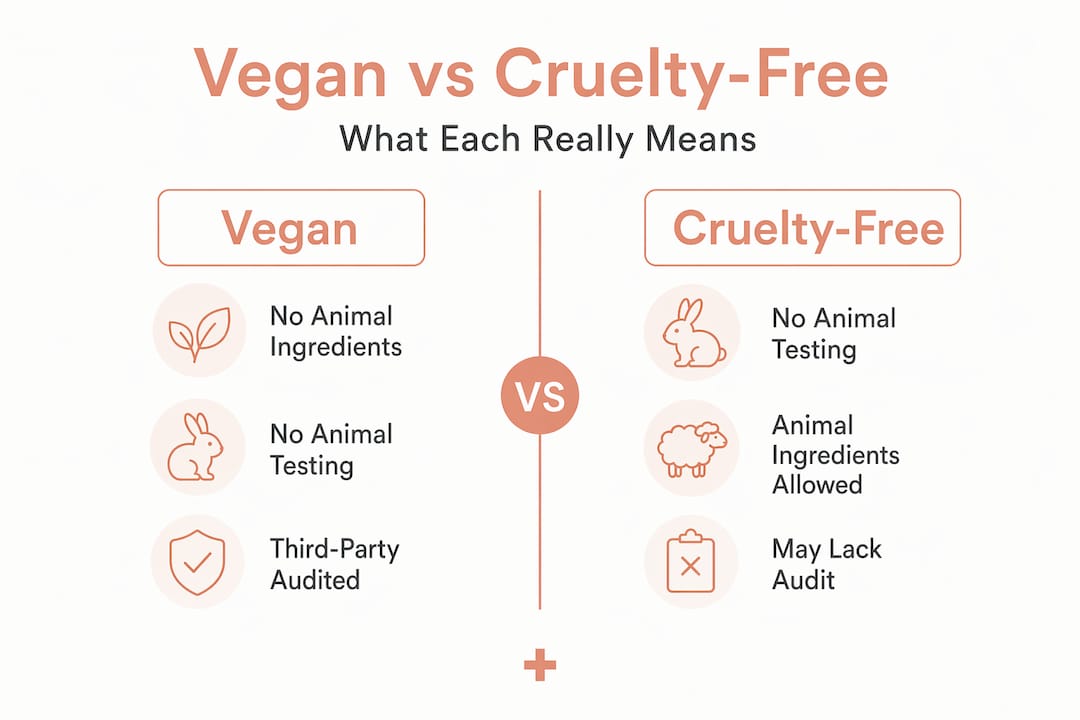
The result is a gap that matters to conscious consumers. Many cruelty-free products may still contain animal-derived ingredients like beeswax, lanolin, or carmine. Conversely, it is technically possible for a product to contain only plant-based ingredients while its manufacturer still conducts animal testing in other parts of the business. That product would not qualify as vegan under any reputable certification standard.
For full animal welfare assurance, checking for both vegan and cruelty-free certification is the reliable approach. One without the other leaves gaps. Yukaface builds both standards into its formulations because the two criteria together represent the complete picture.
If you want to learn more about what specific certifications like Leaping Bunny mean in practice, the Yuka+Face guide on Leaping Bunny certification breaks it down clearly.
How to identify trustworthy vegan skincare
The phrase “vegan” on a label has no legal definition in most markets. Any brand can print it without meeting a specific standard. That is why verification matters more than vocabulary.
Here is what to look for when evaluating a vegan skincare product:
Third-party certification marks — The Vegan Society Trademark, Vegetarian Society Vegan symbol, or NSF Protocol 543 certification all require formal audits. These are not just logos. NSF vegan certification covers supply chain management and manufacturing controls to protect vegan integrity throughout production.
Ongoing compliance, not one-time approval — Reputable vegan certification standards include ongoing auditing and compliance monitoring, not just an initial review. This matters because suppliers change and formulas get updated.
Full ingredient transparency — A trustworthy brand publishes its complete ingredient list and is clear about sourcing. Vague claims like “all natural” or “plant-powered” without an ingredient list are a red flag.
Manufacturing controls — Cross-contamination is a documented risk to vegan product integrity. Certifications require strict standard operating procedures covering ingredient approval, segregation, and traceability, as outlined in NSF operational SOPs.
Honest labeling — The Vegan Trademark explicitly addresses the problem of mislabeling. Verified certification builds real trust because it prevents brands from making claims they cannot back up.
Pro Tip: A brand’s ethical sourcing page or “about” section often reveals more than its product labels. If the brand cannot explain where its ingredients come from, that is useful information too.
Building a vegan skincare routine
Understanding what is vegan skincare is only the first step. Putting it into practice is where the real decisions happen. Here is a straightforward approach to building a routine you can trust.
Identify your skin type and concerns first. Vegan skincare products are available for every skin type, including oily, dry, combination, sensitive, and mature skin. Choosing based on your actual skin needs prevents the common mistake of buying “vegan” without checking if the formula suits your skin.
Start with the basics. Cleanser, moisturizer, and SPF are the foundation. All three are widely available in fully vegan formats. Look for cleansers with plant-based surfactants, moisturizers built around shea butter or hyaluronic acid from fermentation, and mineral SPF options. A solid morning skincare routine anchors everything else.
Check key vegan-friendly actives. Green tea extract delivers antioxidant protection. Peptides in plant-based formulas support collagen structure without animal-sourced input. Hyaluronic acid, niacinamide, and vitamin C are all naturally vegan.
Transition gradually. You do not need to replace everything at once. As products run out, replace them with certified vegan alternatives. This is a practical, sustainable approach that avoids unnecessary waste.
Adjust for the seasons. Your skin’s needs shift throughout the year. Heavier plant-based emollients work better in winter; lighter gel formulas suit summer months. Yukaface’s guide to seasonal skincare changes covers how to adapt your routine without overhauling your entire shelf.
Keep verifying. Brands reformulate products regularly. A product that was vegan last year may have changed its formula. Recheck certifications periodically, especially for products you use consistently.
My honest take on vegan skincare today
Certifications are the most reliable tool consumers have right now, but they are not perfect. I have seen brands with beautiful Vegan Society logos whose broader supply chains raise real questions about environmental impact and labor practices. The certification covers animal welfare. It does not cover everything.
What I find more interesting is the consumer education gap. Most people I speak with genuinely cannot explain the difference between vegan, cruelty-free, and natural when buying skincare. These terms serve different purposes. Treating them as a checklist, as the Vegetarian Society recommends, is genuinely the most practical approach. Vegan covers ingredients. Cruelty-free covers testing. Natural or organic covers how ingredients are grown and processed. You need all three boxes checked if all three things matter to you.
The industry has made real progress on transparency over the last few years. More brands now publish full ingredient sourcing information, and certification bodies are tightening their auditing standards. But the gap between a certified product and a self-declared one is still wide enough to matter. My advice is straightforward: if a product does not carry a recognized third-party mark, treat the “vegan” label as a starting point for your research, not a conclusion.
The good news is that vegan skincare has genuinely caught up in performance terms. The old argument that plant-based formulas cannot compete with conventional products is simply outdated. Botanical research has accelerated significantly, and the best vegan products now outperform many conventional alternatives in categories like hydration, barrier repair, and antioxidant protection.
— Kelly
Whether you are adding vegan skincare to your spa practice or looking to fill gaps in your current routines, the Yukaface vegan skincare guide covers product selection, ingredient guidance, and routine building in one place. For those specifically interested in how vegan skincare supports skin health over time, our guide on aging and skincare offers a practical, non-traditional perspective worth reading. Certified. Transparent. Built for all skin types.
FAQ
What does vegan skincare actually mean?
Vegan skincare means the product contains no animal-derived ingredients and was not tested on animals at any stage of development, including by suppliers.
Is vegan skincare the same as natural skincare?
No. Vegan skincare can include synthetic ingredients. “Natural” refers to ingredient origin, while “vegan” refers to the absence of animal-derived content. A product can be one without being the other.
What is the difference between vegan and cruelty-free skincare?
Cruelty-free means no animal testing. Vegan means no animal-derived ingredients and no animal testing. A product can be cruelty-free but still contain lanolin, beeswax, or other animal-sourced materials.
How can I tell if a vegan skincare claim is genuine?
Look for third-party certification marks from the Vegan Society, Vegetarian Society, or NSF. Self-declared vegan labels without independent auditing carry no formal verification.
Can vegan skincare work for all skin types?
Yes. Vegan skincare products are formulated for every skin type. Skin type compatibility depends on the specific formula, not on whether the product is vegan.