
Your complete guide to mindful skincare with natural ingredients
Skincare shelves are crowded. Labels promise everything: clean, green, natural, cruelty-free, dermatologist-tested. Yet most products lack clear definitions, and many buyers leave overwhelmed, unsure what actually works. Mindful skincare offers a practical, evidence-based path through that noise. This guide covers what mindful skincare really means, which ingredients and tools belong in your starter kit, how to build a step-by-step routine, and how to avoid the most common mistakes. The goal is simple: clear skin, clear choices, clear conscience.
What is mindful skincare?
Mindful skincare is not a trend. It is a framework built on three principles: awareness, intention, and evidence. Awareness means knowing what you put on your skin and why. Intention means each product earns its place in your routine. Evidence means results come from research, not packaging claims.
The holistic angle matters here. Skin is not isolated. Stress, sleep, nutrition, and environment all affect how skin looks and behaves. A mindful routine acknowledges those connections instead of treating skin as a surface problem with a surface solution. Following a mindfulness skincare routine means caring for skin, body, and mind together.
Several misconceptions cloud this space. The most common: “natural” automatically means better and “synthetic” automatically means harmful. Neither is true.
“Natural and clean products are not always superior. They lack regulation, may produce slower results, and can still cause irritation. Conventional products offer tested synthetics for targeted, fast efficacy but come with potential irritants. The best approach is evidence-based ingredients regardless of source.”
The “clean beauty” label has no official legal definition in the United States. Any brand can use it. That does not mean clean or natural products are bad. It means you cannot rely on the label alone. You need to read ingredient lists, understand basic efficacy standards, and apply judgment.
What makes a choice mindful?
Transparent ingredient sourcing
Third-party cruelty-free certification
Minimal processing without unnecessary additives
Support from clinical or peer-reviewed research
Alignment with personal ethics, including vegan and environmental standards
Choosing ethical fragrance insights in your products is one small example of this broader mindful approach. Fragrance is often the last ingredient consumers scrutinize, yet it is one of the most common irritants.
Getting started: Ingredients and tools for holistic skincare
With a clear definition in place, let’s set you up for success by assembling everything you need for a mindful routine backed by research, not marketing.
Research increasingly validates specific botanical ingredients. These are not just folklore favorites. Clinical studies measure their effects with precision. Three stand out for their documented performance.

IngredientKey benefitsDocumented evidenceCentella asiaticaHydration, elasticity, wrinkle reductionHydration +18%, elasticity +22%, wrinkles reduced 15-20%Kanuka oil (3%)Anti-inflammatory, atopic dermatitis reliefSuperior to 1% hydrocortisone for mild atopic dermatitis (ISGA p=0.0082)IsorhamnetinSebum control, pore appearanceReduces sebum 21.1%, pore size 9.6%
These numbers matter. They separate evidence-backed botanicals from the hundreds of plant extracts that appear on labels with no supporting data. Centella asiatica, in particular, has become one of the most studied botanicals in dermatology. Its ability to improve hydration and skin elasticity while visibly reducing wrinkle depth puts it in the top tier of natural actives. Kanuka oil, native to New Zealand, showed statistically significant superiority over a standard topical steroid in a randomized controlled trial for mild atopic dermatitis, making it a serious option for reactive or sensitive skin types.
Learning about hydration and restoration principles will help you understand how these ingredients work together in a layered routine rather than in isolation.
What to look for on product labels:
Certified organic where possible
Leaping Bunny or PETA cruelty-free certified
Minimal ingredient lists with recognizable components
Absence of unnecessary fillers, artificial dyes, and undisclosed fragrance
Peer-reviewed or clinical support referenced by the brand
Starter toolkit for a mindful routine:
Gentle, pH-balanced cleanser
Hydrating facial mist or essence
Antioxidant serum (look for Centella asiatica or vitamin C)
Broad-spectrum mineral sunblock (SPF 30 minimum)
Lightweight, barrier-supporting moisturizer
Reading the vegan skincare guide is a useful next step for anyone building their first holistic kit from scratch.
Pro Tip: Patch-test every new product before full application, even when it carries natural or organic certification. Apply a small amount to the inner forearm or behind the ear for 24 to 48 hours. Natural ingredients like essential oils can cause allergic reactions in some individuals. Testing protects the skin and saves money.
Step-by-step: Crafting your mindful skincare routine
Now, let’s turn preparation into action with a mindful routine you can personalize and repeat with intention.
A mindful routine has structure, but it is not rigid. Morning and evening routines serve different purposes. Morning focuses on protection. Evening focuses on repair and restoration.
Morning routine:
Cleanse with a gentle, sulfate-free cleanser. Use lukewarm water.
Apply a hydrating mist or toner. Pat, do not rub.
Layer an antioxidant serum. Centella asiatica or isorhamnetin formulas work well.
Apply moisturizer. Choose one suited to your skin type.
Finish with a broad-spectrum mineral sunblock. This is non-negotiable.
Evening routine:
Double cleanse if you wore sunblock or makeup. An oil-based cleanser first, then a gentle water-based one.
Apply a targeted treatment serum. This is the moment for actives that target specific concerns.
Use a barrier-repair moisturizer or facial oil.
Allow products to absorb fully before sleeping.
Following structured morning skincare steps helps build the habit until it becomes automatic. Consistency matters more than perfection.
Mindful vs. standard skincare: a direct comparison
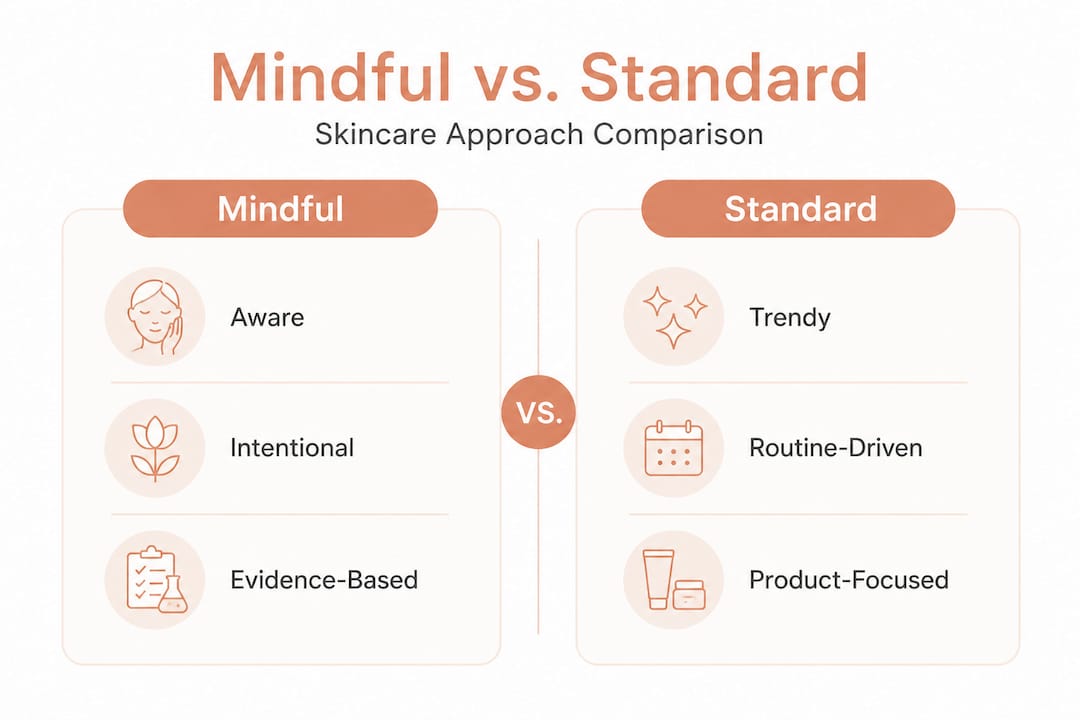
FactorMindful skincareStandard approachProduct selectionEvidence-based, intentionalTrend-driven, marketing-ledApplicationSlow, deliberate, breathing-awareQuick, task-focusedIngredient awarenessHigh, label-reading habitLow, trust in brand claimsStress impactRoutine reduces cortisolRoutine adds to daily rushSustainabilityCruelty-free, minimal wasteVariable, often not prioritizedLong-term outcomesGradual, stable improvementVariable, can cause overuse damage
Botanical skincare routines backed by randomized controlled trials show clinical improvements in barrier function, scar appearance, and signs of aging over consistent use. Research also highlights that specific plant-derived antimicrobials, including Houttuynia cordata essential oil, show measurable IC50 values against acne-causing bacteria, offering a natural alternative to conventional antibacterial actives.
One often overlooked element: breathing. During application, slow the process. Three deep breaths between steps is enough to shift the nervous system out of stress mode. This reduces cortisol, which directly affects skin inflammation and sebum production. Pairing calm skin confidence practices with a physical routine doubles the benefit.
Pro Tip: Adjust your products with the seasons. In winter, layer a richer moisturizer and reduce exfoliation frequency. In summer, lighten your base and increase antioxidant protection. Skin needs shift with hormonal cycles too. If you notice breakouts or dryness during specific times of the month, adjust actives accordingly rather than sticking rigidly to one fixed routine.
What to watch for: Common pitfalls and myth-busting
Even well-intentioned, evidence-based routines can go wrong. Let’s shine a light on the common obstacles and misperceptions mindful practitioners face.
Common pitfalls in natural skincare:
Chasing trends. A new ingredient goes viral, and suddenly it is in everything. Most viral ingredients have limited clinical data. Stick to what research supports.
Over-exfoliating. More scrubbing does not mean better skin. Over-exfoliation strips the skin barrier, causing redness, sensitivity, and increased breakouts. Two to three times per week is the general maximum for chemical exfoliants.
Assuming natural means non-irritating. Essential oils, citrus extracts, and certain plant acids can cause significant irritation or photosensitivity. The source of an ingredient does not determine its tolerance level for every skin type.
Skipping sunblock. This is the single most preventable cause of premature skin aging and uneven tone. Natural mineral sunblocks with zinc oxide offer broad-spectrum protection without synthetic chemical filters.
Using too many actives at once. Layering multiple strong actives (vitamin C, AHA, retinol or a botanical equivalent) in one routine can cause barrier disruption. Introduce one new active at a time.
Myth-busting:
“There is no official regulatory definition for ‘clean beauty.’ Effectiveness is determined by formulation quality, not by whether a product is labeled natural or synthetic. Hybrid approaches, combining the best of both worlds, consistently deliver optimal results.”
This is not a criticism of natural skincare. It is a call for critical thinking. A well-formulated vegan serum with clinically studied botanicals outperforms a poorly formulated synthetic product every time. And a precisely dosed synthetic ingredient in a cruelty-free base can outperform a raw plant extract that was never studied for skin bioavailability.
The best mindful skincare practitioners treat their skin like a feedback system. Redness, dryness, breakouts, or texture changes are information. They signal an adjustment is needed, not a failure. Exploring mindful self-care routines that go beyond skin surface can help you develop that observational habit without judgment.
Why evidence—not hype—makes mindful skincare revolutionary
There is a common split in the skincare world: “all-natural” purists on one side, and those who trust only pharmaceutical-grade synthetics on the other. Both camps make the same mistake. They trust a category label more than the actual evidence.
Real-world cases illustrate this repeatedly. Someone commits to an exclusively raw, all-natural routine, layering unrefined plant oils without understanding comedogenic ratings or oxidation risk. The result is clogged pores or rancid-oil induced breakouts, often blamed on “detox.” On the other side, someone adopts an aggressive clinical regimen of high-percentage acids and prescription retinoids, stripping the barrier down to chronic sensitivity. Both outcomes are preventable with evidence-first thinking.
The revolutionary act in skincare is not choosing natural or synthetic. It is choosing what works, safely, ethically, and sustainably. That means reading peer-reviewed data, understanding your own skin’s responses, and refusing to be moved by packaging or influencer endorsement alone. Following an unbothered skin philosophy means you observe, adjust, and stay consistent rather than panic-buying the next trending active.
At Yuka+Face, the position is clear: botanical research and scientific expertise are not opposites. They are partners. Every ingredient in our formulas is chosen because clinical evidence supports its efficacy and safety profile, not because it sounds good on a label. The commitment to vegan, cruelty-free, and environmentally conscious sourcing means ethics are built into efficacy, not added as an afterthought.
Mindful skincare is most powerful when it is personal. No routine works perfectly for every skin type, age, or climate. The practice of paying attention to how your skin responds, adjusting with the seasons and life changes, and making choices grounded in data rather than fear or hype is what creates lasting results.
Take the next step with mindful, cruelty-free skincare
Ready to move from theory and self-exploration to tried-and-true solutions and richer resources? Yuka+Face supports evidence-led, cruelty-free routines with practical guides and thoughtfully formulated products for all skin types and ages.

Start with the vegan skincare guide for a full breakdown of cruelty-free ingredient standards. Build your daily habit with the structured morning skincare routine, designed for consistency and skin health. For those weighing botanical alternatives to conventional retinol, the plant-based retinol comparison covers the clinical data on bakuchiol versus retinol side by side. Each guide connects to the same core philosophy: natural, vegan, evidence-backed skincare that lets your skin’s radiance show through without compromise.
Frequently asked questions
Are natural skincare products always better for sensitive skin?
Not always. Natural does not guarantee non-irritating, so patch-testing and evidence-based choices are the safest approach for any skin type, especially reactive or sensitive skin.
What ingredient should I prioritize in a holistic, mindful routine?
Evidence-backed botanicals like Centella asiatica are a strong starting point, with documented improvements in hydration of 18%, elasticity by 22%, and visible wrinkle reduction of 15 to 20%.
Can mindful skincare routines combine natural and synthetic products?
Yes. The most effective routines use safe, evidence-based options from both natural and synthetic sources, prioritizing formulation quality and clinical support over category labels.
How long until I see results with mindful skincare?
Results vary by concern and starting point, but consistent use of clinically supported ingredients like Centella asiatica shows measurable improvements in hydration and texture within four to eight weeks in controlled studies.
Recommended
Achieve Confidence and Calm Skin: Essential Tips for Radiant Health — Yuka+Face
Discover the Unbothered Skin Philosophy for Radiant, Stress-Free Skin — Yuka+Face
Holistic skincare: Simple routines, real results in 2026 – SMPL SKIN South Africa
Regenerative skincare ingredients: science-backed guide – Cellure