What Is Sustainable Beauty? A Full Lifecycle Guide
What Is Sustainable Beauty? A Full Lifecycle Guide
TL;DR:
- Sustainable beauty involves designing and using products that minimize environmental and social harm throughout their entire lifecycle. It emphasizes responsible sourcing, eco-friendly packaging, responsible manufacturing, and fair labor practices, extending beyond ingredient safety. Incremental consumer choices, combined with scientific industry measures like life cycle assessments, are key to advancing sustainability in the beauty industry.
Sustainable beauty is defined as the practice of designing and using beauty products that reduce environmental and social harm across the entire product lifecycle, from ingredient sourcing through to disposal. This goes well beyond reading an ingredient label. The term covers manufacturing emissions, packaging waste, transport logistics, and how you dispose of a product when it runs out. Brands like Yukaface, along with industry frameworks like Life Cycle Assessment (LCA) and circular economy principles, are shaping what this practice looks like in real product development. Understanding what sustainable beauty actually means helps you cut through marketing noise and make choices that hold up under scrutiny.
What is sustainable beauty and why does the full lifecycle matter?
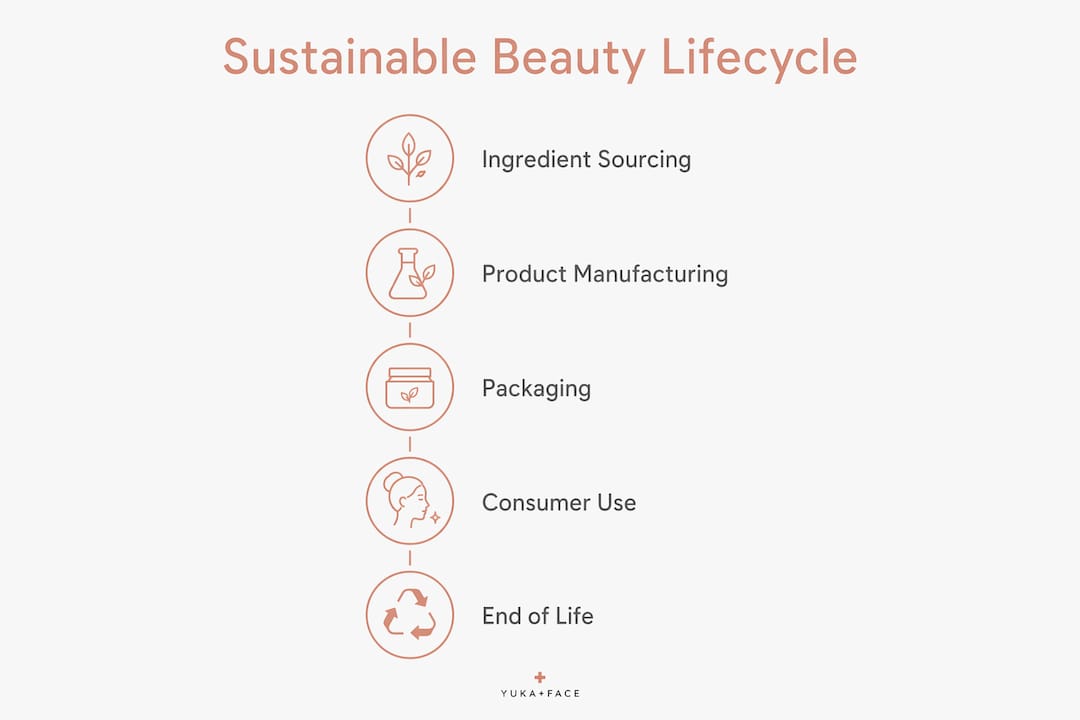
Sustainable beauty is not a single ingredient standard or a certification logo. It is a full lifecycle concept that addresses environmental and social harm at every stage a product passes through. That includes where ingredients come from, how a factory runs, what the bottle is made of, how far the product travels, how you use it, and what happens when it is empty.

Each of these stages carries its own footprint. A face oil made from organic botanicals can still generate significant carbon emissions if it is manufactured in an energy-intensive facility and shipped across three continents in non-recyclable packaging. No single stage tells the full story.
Sustainable beauty products use responsibly sourced natural and organic ingredients and prioritize eco-friendly, recyclable, biodegradable, or refillable packaging to reduce waste. That combination of ingredient responsibility and packaging responsibility is the baseline. The more rigorous definition also pulls in social factors: fair wages, safe working conditions, and ethical treatment throughout the supply chain.
The core principles of eco-conscious beauty break down across these lifecycle stages:
- Ingredient sourcing. Ingredients should be grown or harvested with minimal ecological disruption, using renewable resources and traceable supply chains.
- Manufacturing. Responsible production reduces water consumption, energy use, and greenhouse gas emissions at the factory level.
- Packaging. Recyclable, refillable, or biodegradable containers reduce the volume of material that ends up in landfill.
- Transport and logistics. Shorter supply chains and lower-emission shipping reduce the carbon cost of getting a product to your door.
- Consumer use. How much product you use per application and how long a product lasts both affect total resource consumption.
- Disposal. Proper end-of-life handling, including take-back programs and correct recycling, determines whether packaging materials are actually recovered.
- Social responsibility. Ethical labor practices and fair treatment throughout manufacturing are integral to any credible sustainability claim.
How does sustainable beauty differ from clean and natural beauty?
Many consumers treat “natural,” “clean,” and “sustainable” as interchangeable. They are not. Each term targets a different part of the product story, and confusing them leads to purchasing decisions that do not deliver the environmental benefit you expect.
Clean beauty focuses on excluding specific ingredients considered harmful to human health, such as parabens, sulfates, or synthetic fragrances. It says nothing about how those remaining ingredients were sourced, how the factory operates, or what the packaging does after use. Clean beauty is about what is not in the formula. Sustainable beauty is about what happens at every stage.
Natural beauty emphasizes ingredient origin, prioritizing plant-derived or mineral-based materials over synthetic ones. The problem is that natural products do not inherently guarantee sustainability due to land use, water consumption, biodiversity impacts, and traceability issues. Palm oil is natural. Its production has driven deforestation across Southeast Asia. Origin alone is not a sustainability credential.
For a direct comparison, the table below shows where each concept focuses:
| Concept | Primary Focus | Lifecycle Coverage |
|---|---|---|
| Clean Beauty | Ingredient safety for humans | Ingredient list only |
| Natural Beauty | Ingredient origin (plant/mineral) | Ingredient sourcing only |
| Sustainable Beauty | Environmental and social impact | Full lifecycle, cradle to disposal |
Pro Tip: When evaluating a brand’s sustainability claims, look for specific lifecycle disclosures, such as carbon footprint data, packaging material percentages, or supplier audit reports, rather than vague terms like “eco-friendly” or “green.”
For a deeper look at where clean beauty ends and sustainable beauty begins, the clean vs. sustainable distinction is worth exploring in full.
How to achieve sustainable beauty: practical swaps that actually work
Adopting sustainable beauty practices does not require replacing your entire routine overnight. The highest-impact changes are usually the simplest ones, and they center on packaging choices and consumption habits rather than ingredient lists.
-
Finish what you have before buying new. Overconsumption is one of the largest drivers of beauty waste. Simplifying your routine and using multipurpose products reduce overall resource use and packaging waste. A single well-formulated facial oil can replace a serum, a moisturizer, and a treatment product.
-
Choose products with minimal or recyclable packaging. Reducing single-use plastics and selecting products that use recycled-content materials or take-back programs cuts the volume of packaging that reaches landfill.
-
Understand what “recyclable” actually means in your area. Recyclable labels on beauty packaging can be misleading. Many packages require special handling and depend entirely on local recycling infrastructure to be processed correctly. A pump dispenser made from mixed materials may be technically recyclable but rejected by most curbside programs. Check your local guidelines before assuming a product is handled responsibly.
-
Prioritize refillable formats where they genuinely save material. Refill systems reduce packaging waste only when the refill container uses significantly less material than the original and when you actually reuse the primary packaging enough times to offset its production cost. A refill pouch that saves 80% of the plastic versus a full bottle is a real gain. A refill that comes in nearly identical packaging is not.
-
Support brands with transparent sourcing and social ethics. Look for brands that publish supplier information, hold third-party certifications such as Leaping Bunny or B Corp, and disclose their manufacturing standards. Transparency is the clearest signal that a sustainability claim is backed by practice.
-
Choose eco-friendly beauty product formats that reduce water use. Solid shampoo bars, concentrated serums, and waterless cleansers require less water in formulation and often ship in lighter, smaller packaging. Both factors reduce environmental impact compared to conventional water-heavy formulas.
Pro Tip: Glass and aluminum packaging are generally more recyclable than plastic in most U.S. municipalities. When choosing between two comparable products, the packaging material is often the more meaningful sustainability variable than the ingredient list.
For a structured approach to building these habits into a daily practice, the sustainable skincare routine guide from Yukaface covers the steps in detail.
How science and industry measure sustainable beauty
The beauty industry uses formal scientific methods to assess and improve sustainability performance. The most widely applied tool is Life Cycle Assessment, or LCA. LCA measures sustainability performance in cosmetics by quantifying environmental impact at each product stage, helping brands reduce carbon footprint and virgin material extraction. It converts abstract claims like “lower impact” into measurable data points across categories including energy use, water consumption, and greenhouse gas emissions.
A second major framework is the circular economy model. Circular economy approaches in cosmetic R&D valorize agro-industrial side streams, meaning they find uses for agricultural byproducts that would otherwise be discarded. Grape seed extract from winemaking waste, rice bran from milling, and tomato seed oil from food processing are all examples of ingredients recovered from industrial byproducts rather than grown as primary crops. This reduces reliance on virgin resources and lowers the land use footprint of a formula.
The table below summarizes the main scientific and industry approaches used to assess beauty sustainability:
| Method | What It Measures | Primary Benefit |
|---|---|---|
| Life Cycle Assessment (LCA) | Environmental impact across all product stages | Quantifies carbon, water, and material footprint |
| Circular Economy Sourcing | Use of agro-industrial byproducts as ingredients | Reduces virgin resource extraction |
| Take-Back Programs | Post-consumer packaging recovery rates | Increases actual recycling rates |
| Third-Party Certification | Supply chain ethics and ingredient standards | Verifies claims independently |
Scaling these approaches remains a real challenge. LCA requires detailed supplier data that many smaller brands cannot access. Circular sourcing depends on consistent supply from food and agricultural industries. Certification costs can be prohibitive for independent brands. These constraints mean that sustainability claims must be verified carefully rather than accepted at face value. The gap between a brand’s stated values and its measurable practices is where most greenwashing lives.
Key takeaways
Sustainable beauty requires full lifecycle accountability, not just clean ingredients or recyclable packaging claims.
| Point | Details |
|---|---|
| Lifecycle scope | Sustainable beauty covers ingredients, manufacturing, packaging, transport, use, and disposal. |
| Natural does not mean sustainable | Natural ingredients can carry high land, water, and biodiversity costs without proper sourcing controls. |
| Packaging is high impact | Choosing recyclable, refillable, or minimal packaging is one of the highest-leverage consumer actions. |
| Verify recycling claims locally | Recyclable labels depend on local infrastructure; check your municipality’s guidelines before assuming. |
| Science backs the claims | LCA and circular economy sourcing give brands measurable tools to reduce footprint beyond marketing language. |
The lifecycle lens is the only one that holds up
I have spent years reading beauty sustainability claims, and the pattern is consistent. Brands lead with ingredients because ingredients are visible and easy to market. Packaging is harder to talk about because it requires admitting trade-offs. Manufacturing emissions are almost never mentioned because most brands do not measure them.
The consumers I find most effective at making genuinely sustainable choices are the ones who have stopped asking “what is in this product” and started asking “what happens to this product.” That shift in question changes everything. A beautifully formulated serum in a non-recyclable pump bottle with a component count of six different plastics is not a sustainable product, regardless of how many organic botanicals it contains.
The other thing I have learned is that gradual adoption works better than perfection. Replacing one product at a time with a more considered option, finishing what you already own, and learning your local recycling rules are more impactful than a complete routine overhaul. The ethical sourcing choices that brands make matter, but so do the small, consistent decisions you make every time you buy or dispose of a product.
Sustainable beauty is not a destination. It is a direction. Moving toward it, even incrementally, is the point.
— Kelly
Yukaface: vegan skincare built on sustainable principles
Yukaface formulates every product with 100% natural, vegan, and cruelty-free ingredients, designed for all skin types and ages. The focus is on botanical research combined with scientific formulation, so each product delivers real results without unnecessary environmental cost.
If you are building a more considered skincare routine, the vegan skincare guide from Yukaface is a practical starting point. It covers ingredient choices, routine structure, and how to align your daily practice with sustainable beauty values. For a mindful approach to daily skin care, the mindfulness skincare routine offers a framework that connects product use to intentional, low-waste habits. Both resources reflect the Yukaface philosophy: skin care that works for your skin and for the planet.
FAQ
What is sustainable beauty in simple terms?
Sustainable beauty refers to products and practices designed to reduce environmental and social harm across the full product lifecycle, from ingredient sourcing to disposal. It covers packaging, manufacturing, transport, and end-of-life handling, not just what is in the formula.
Is natural beauty the same as sustainable beauty?
No. Natural beauty focuses on ingredient origin, but natural ingredients can still carry high environmental costs due to land use, water consumption, and biodiversity impacts. Sustainable beauty requires responsible sourcing, production, and disposal across all stages.
What makes packaging sustainable in beauty products?
Sustainable packaging uses recyclable, biodegradable, or refillable materials and minimizes total material volume. Recyclable labels alone are not enough; effective recycling depends on local infrastructure and whether the packaging design is compatible with available processing systems.
How do brands measure their sustainability performance?
The primary scientific tool is Life Cycle Assessment (LCA), which quantifies environmental impact across all product stages including carbon footprint and raw material use. Third-party certifications such as B Corp or Leaping Bunny provide independent verification of specific claims.
What is the most impactful sustainable beauty swap a consumer can make?
Reducing overconsumption and choosing products with minimal or refillable packaging deliver the greatest impact. Finishing products before buying new ones and selecting multipurpose formats reduce both resource use and packaging waste more effectively than switching ingredients alone.