
What Is Skin Barrier? Your Guide to Healthier Skin
What Is Skin Barrier? Your Guide to Healthier Skin
TL;DR:
- The skin barrier is a complex, multilayered system that protects against environmental threats while maintaining hydration. Damage from harsh products, environmental factors, and genetic mutations impairs this barrier, leading to dryness, irritation, and increased susceptibility to infections and conditions like atopic dermatitis. Repair involves a gentle routine focused on restoring lipids, locking in moisture, and protecting against UV damage, with consistent care showing results within weeks.
The skin barrier is defined as the outermost layer of your skin that shields your body from environmental threats while locking in the moisture your cells need to function. Clinically, this structure is called the stratum corneum, and it operates as a physical, chemical, and microbial defense system all at once. Its integrity determines how your skin looks, feels, and responds to the world around it. When it works well, your skin stays hydrated, calm, and resilient. When it breaks down, everything from dryness to chronic inflammation can follow. Understanding what the skin barrier is and how it works is the foundation of any effective skincare approach.
What is the skin barrier and how is it structured?
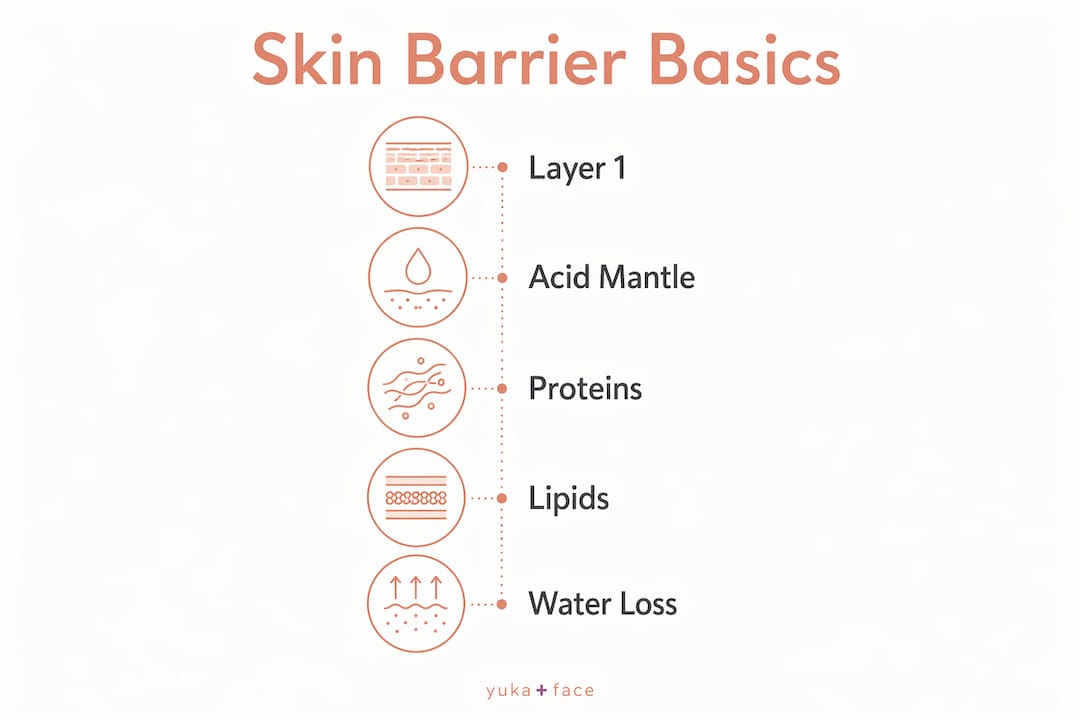
The skin barrier is primarily the stratum corneum, a tough, flexible outer layer made of corneocytes embedded in a lipid matrix of ceramides, cholesterol, and free fatty acids. Scientists describe this arrangement as a “brick-and-mortar” structure. The corneocytes are the bricks, and the lipids are the mortar holding everything together. This architecture is what gives the barrier its ability to block germs, allergens, and irritants while preventing water from escaping.

Beneath this physical structure sits the acid mantle, a thin film of sweat and sebum that maintains a slightly acidic pH on the skin’s surface. This acidity is not incidental. It acts as a chemical buffer against microbial growth and supports the enzymes that keep the barrier intact. Acid mantle disruption leads to increased colonization of pathogens, enzymatic imbalance, and barrier impairment, particularly in conditions like atopic dermatitis. Understanding pH balance in skincare is one of the most underrated aspects of maintaining a healthy barrier.
Two proteins deserve specific attention here. Filaggrin is a structural protein that helps bind corneocytes together and contributes to the skin’s natural moisturizing factors. Keratinocytes are the living cells that produce corneocytes as they mature and migrate toward the surface. Both are central to how the barrier forms and renews itself over time.
Pro Tip: Ceramides make up roughly 50% of the lipid content in the stratum corneum. If your moisturizer does not list ceramides as an active ingredient, it may be hydrating the surface without actually rebuilding the barrier.
Skin barrier function also depends on a measurable process called transepidermal water loss, or TEWL. Increased TEWL indicates barrier dysfunction, increased permeability, dryness, and greater susceptibility to irritants and allergens. Dermatologists use TEWL measurements as a clinical benchmark for barrier integrity, making it one of the most objective tools available for tracking repair progress.
What causes skin barrier damage?
Barrier damage rarely comes from a single source. The most common causes include:
- Harsh cleansers and soaps that strip the skin’s natural lipids and disrupt the acid mantle
- Over-exfoliation, which physically removes the protective corneocyte layer faster than it can regenerate
- UV radiation and pollution, which elevate oxidative stress and disrupt barrier lipids and proteins
- Genetic factors, particularly filaggrin loss-of-function mutations that reduce the barrier’s structural integrity from birth
- Low humidity and cold weather, which accelerate TEWL and dehydrate the stratum corneum
- Fragrance and alcohol in skincare products, which are among the most common contact irritants
Filaggrin mutations deserve extra attention because they are not a lifestyle choice. Filaggrin loss-of-function mutations impair barrier integrity and increase the risk of atopic dermatitis and skin infections. People with these mutations produce less of the protein that holds corneocytes together, which reduces the skin’s natural moisturizing factors and lowers the acid mantle’s effectiveness. The result is a barrier that is structurally weaker before any external stressor even enters the picture.
Recognizing signs of skin barrier damage early makes a significant difference in how quickly you can address them. Common symptoms include:
- Persistent dryness or flakiness that does not respond to standard moisturizers
- Redness, irritation, or a burning sensation after applying products that previously caused no reaction
- Itching without an obvious cause
- Skin that feels tight, especially after cleansing
- Sudden sensitivity to products you have used for months
- Frequent breakouts or skin infections
Barrier impairment often results in reduced tolerance to skincare products and greater susceptibility to skin infections. This is why a damaged barrier and acne can appear together. The compromised surface allows bacteria to penetrate more easily, triggering inflammation that shows up as breakouts.
How does barrier dysfunction connect to atopic dermatitis?
Atopic dermatitis (AD) is the clearest example of what happens when skin barrier function fails at a systemic level. The connection between barrier defects and AD is not a one-way street. Barrier dysfunction is both a cause and a perpetuator of disease processes, which is why early intervention matters so much.
The table below outlines the key differences between a healthy barrier and one compromised by atopic dermatitis:
| Factor | Healthy barrier | Barrier in atopic dermatitis |
|---|---|---|
| Filaggrin levels | Normal, supports hydration and pH | Reduced due to genetic mutations |
| Lipid composition | Balanced ceramides, cholesterol, fatty acids | Disrupted, reduced ceramide content |
| TEWL | Low, moisture retained effectively | Elevated, significant water loss |
| Microbial environment | Diverse, balanced skin microbiome | Staphylococcus aureus overgrowth common |
| Immune response | Regulated, low baseline inflammation | Chronic activation of IL-4 and IL-13 pathways |
The cytokines IL-4 and IL-13 are particularly significant. These immune signaling molecules drive the inflammatory response in AD and also directly suppress filaggrin production, creating a feedback loop where inflammation worsens the barrier defect that triggered the inflammation in the first place. Staphylococcus aureus colonization adds another layer of complexity. Filaggrin deficiency alters stratum corneum hydration and pH, promoting microbial growth and complicating the AD disease course. Treating AD effectively requires addressing the barrier, not just the inflammation.
How to repair and strengthen your skin barrier
Skin barrier repair typically involves multiple supportive strategies rather than a single ingredient. A multilevel approach is most effective, and practitioners consistently endorse three core pillars: reduce disruption, lock in moisture, and restore lipid structure.
Here is a practical framework for applying those pillars:
- Simplify your routine. Remove any product containing fragrance, alcohol, or physical exfoliants until the barrier has recovered. Fewer products mean fewer potential irritants.
- Switch to a gentle, pH-balanced cleanser. Alkaline soaps raise skin pH above its natural range of 4.5 to 5.5, which disrupts enzyme activity and weakens the acid mantle.
- Apply a ceramide-rich moisturizer immediately after cleansing. Applying within two minutes of washing traps residual moisture before TEWL can remove it. Look for products listing ceramide NP, ceramide AP, or ceramide EOP on the label.
- Add hyaluronic acid as a humectant layer. Hyaluronic acid draws water into the stratum corneum and holds it there, supporting the lipid matrix from the inside.
- Use plant oils strategically. Oils like rosehip, jojoba, and squalane mimic the skin’s natural lipids and help fill gaps in the mortar layer without clogging pores.
- Protect against UV daily. UV radiation is one of the most consistent external drivers of barrier lipid disruption, and daily SPF use is non-negotiable for repair and maintenance.
For a deeper look at what works, the Yukaface guide on repairing your barrier naturally covers ingredient-level strategies in detail. You can also explore what damages the skin barrier to identify specific triggers in your current routine.
Pro Tip: Petrolatum, the active ingredient in plain petroleum jelly, remains one of the most clinically validated occlusive agents for barrier repair. It reduces TEWL by up to 98% and costs a fraction of most specialty barrier creams. Use it as a final step at night over your moisturizer.
Barrier repair is gradual and requires consistent supportive care. Most people see measurable improvement within two to four weeks when they follow a simplified, ingredient-focused routine. For a clear timeline on what to expect, the Yukaface article on how long repair takes breaks it down week by week.
Key takeaways
The skin barrier is a multilayered physical, chemical, and microbial defense system, and repairing it requires addressing all three layers simultaneously rather than relying on a single product.
| Point | Details |
|---|---|
| Barrier structure | The stratum corneum’s brick-and-mortar architecture of corneocytes and lipids is the core of barrier function. |
| TEWL as a measure | Elevated transepidermal water loss signals barrier dysfunction and guides repair progress objectively. |
| Damage causes | UV radiation, harsh cleansers, filaggrin mutations, and low humidity are the primary drivers of barrier breakdown. |
| AD connection | In atopic dermatitis, barrier dysfunction and immune activation form a cycle that requires early, targeted care. |
| Repair strategy | Reduce disruption, apply ceramides and hyaluronic acid, and protect with SPF for consistent barrier recovery. |
Why the skin barrier deserves more attention than it gets
Most people treat skincare as a cosmetic concern. They reach for a new serum when their skin looks dull or add a spot treatment when breakouts appear. What they miss is that almost every skin complaint, from sensitivity to chronic dryness to recurring acne, traces back to barrier function. I have seen this pattern repeatedly. People cycle through products looking for the one that will fix their skin, when the real issue is that their barrier is too compromised to respond to anything properly.
The most common misconception is that more products equal better results. The opposite is usually true for a damaged barrier. Every additional active ingredient is another potential irritant, and a barrier that is already struggling cannot process them effectively. Stripping back to basics, a gentle cleanser, a ceramide moisturizer, and SPF, consistently outperforms a ten-step routine for people whose barrier is impaired.
What I find most compelling about barrier science is that it reframes skin health as a systemic issue rather than a surface one. The importance of skin barrier health extends beyond appearance. It regulates fluid balance, protects against infection, and modulates immune responses. Treating it as a cosmetic afterthought is a significant underestimation of what your skin actually does for you. Start with the barrier. Everything else follows from there.
— Kelly
Support your skin barrier with Yukaface

Yukaface formulates every product with the skin barrier in mind. The full range is vegan, natural, and built around ingredients like ceramides, plant oils, and botanical extracts that support barrier repair without synthetic irritants. Whether you are starting a new routine or rebuilding after damage, the Yukaface guide to vegan skincare is the right starting point. It covers ingredient selection, routine structure, and how to choose products suited to your skin type. For daily barrier protection, the morning skincare routine guide walks through each step with product recommendations designed to protect and restore. Clean formulas. Clear results.
FAQ
What is the skin barrier made of?
The skin barrier is made of the stratum corneum, a layer of corneocytes embedded in lipids including ceramides, cholesterol, and free fatty acids. This structure forms the primary physical and chemical defense between your body and the environment.
What are the main signs of a damaged skin barrier?
Symptoms of a compromised barrier include persistent dryness, redness, itching, tightness after cleansing, and sudden sensitivity to products you previously tolerated. Frequent breakouts or skin infections can also indicate barrier impairment.
How long does it take to repair the skin barrier?
Most people see measurable improvement within two to four weeks of following a simplified, barrier-focused routine. Full recovery depends on the severity of damage and consistency of care.
What ingredients repair the skin barrier most effectively?
Ceramides, hyaluronic acid, petrolatum, and plant oils like squalane and jojoba are the most evidence-supported ingredients for barrier repair. A multilevel repair approach combining these ingredients consistently outperforms single-ingredient solutions.
Does the skin barrier affect acne?
A compromised barrier increases skin permeability, allowing bacteria and irritants to penetrate more easily and trigger inflammation that presents as breakouts. Strengthening the barrier reduces this vulnerability and can improve acne frequency over time.
Recommended
- Essential Guide to Skin Barrier Health: Restore and Protect Your Skin — Yuka+Face
- Skin Barrier vs Dehydration: Understanding and Caring for Your Skin — Yuka+Face
- What Damages the Skin Barrier and How to Repair It Effectively — Yuka+Face
- Repairing the Skin Barrier Naturally: Tips for Healthier, Glowing Skin — Yuka+Face