
What Is pH in Skincare and Why It Matters
TL;DR:
Understanding pH in skincare helps maintain your skin’s natural acidity, essential for barrier health and ingredient effectiveness. Using products close to your skin’s natural pH (around 4.5 to 5.5) supports microbiome diversity, prevents irritation, and enhances routine results. Proper pH balance is crucial for optimal ingredient activation and long-term skin health, yet transparency in formulations remains limited.
Most people scanning product labels have seen pH mentioned without fully understanding what it means for their skin. What is pH in skincare? Simply put, it’s the measure of how acidic or alkaline a product is, and that number has a direct impact on how your skin functions, how ingredients perform, and whether your barrier stays intact. Get it wrong, and even the most expensive serum can do more harm than good. Get it right, and your entire routine starts working the way it should.
Table of Contents
What is pH in skincare and how the scale works
pH stands for “potential of hydrogen” and measures how acidic or alkaline a water-based formula is on a scale of 0 to 14. A pH of 7 is neutral. Anything below 7 is acidic. Anything above 7 is alkaline. For skincare, this matters because almost every product that touches your face is water-based, and water-based formulas interact directly with your skin’s chemistry.
One thing worth clarifying: oils don’t have a pH value. pH measurement only applies to aqueous, or water-containing, formulas. So when you’re evaluating a face oil, pH is irrelevant. When you’re evaluating a cleanser, toner, serum, or moisturizer, it becomes one of the most important numbers in the formula.
pH doesn’t just describe a product. It controls what that product actually does.
Ingredient activation: Many active ingredients only work within a narrow pH window. Outside that range, they’re inactive or unstable.
Preservative function: Organic acid preservatives lose efficacy above pH 6, which affects product safety and shelf life.
Texture and sensory feel: pH influences how a formula feels on skin, how it spreads, and how quickly it absorbs.
Skin surface reaction: A product that’s too alkaline can immediately disrupt your skin’s natural acidity, even if it contains good ingredients.
Pro Tip: Lathering soaps are typically pH 9 to 10. That’s why using bar soap on your face so often causes tightness and flaking. It’s not the soap stripping oils. It’s the high pH disrupting your acid mantle.
The skin’s natural pH and why it needs protection
Healthy skin is naturally acidic. The skin’s normal pH ranges from 4.5 to 6.5, with the most optimal zone sitting closer to 4.5 to 5.5. This acidity isn’t random. It’s the result of a complex biological system called the acid mantle, a thin film produced by sebaceous and sweat glands that sits on the surface of the stratum corneum.
The acid mantle has been studied for over a century, and science continues to confirm its importance. It does several things simultaneously:
Inhibits the growth of harmful bacteria, including Staphylococcus aureus, which is linked to eczema flares
Supports the enzymes that regulate skin cell turnover and repair
Maintains the lipid structure in the stratum corneum to minimize water loss
Creates an environment where beneficial microbiome bacteria can thrive
When pH rises, even slightly, these functions degrade. Disruptions to skin pH impair enzyme activity, weaken the barrier, and alter the microbiome in ways that trigger inflammation, dryness, and increased sensitivity. This isn’t a temporary effect. Repeated disruption from high-pH products leads to cumulative barrier damage.
“Maintaining acidic pH in the stratum corneum is emerging as a potential therapeutic target for inflammatory skin disorders, offering new approaches beyond symptom management.” — The Skin Acid Mantle: An Update on Skin pH
The microbiome connection is especially significant. A clinical study found that low-pH products increased microbial diversity and reduced opportunistic pathogens after 28 days of use, without harming the overall balance of beneficial bacteria. That’s a meaningful result. It shows that pH isn’t just about surface feel. It actively shapes the microbial ecosystem living on your skin.
pH also varies across different parts of the body. The face tends to sit slightly higher than other areas, and skin folds maintain a more acidic environment due to moisture and warmth. Understanding this variability helps explain why the same product can feel fine on your arm but irritating on your cheeks.
pH levels in beauty products and how they affect ingredients
Not all skincare products are formulated to the same pH, and they shouldn’t be. Each product category has an optimal range based on what it needs to do, what active ingredients it contains, and where it sits in a routine.
Product typeTypical pH rangeKey reasonVitamin C serum2.6 to 3.2Ascorbic acid is unstable above pH 3.5AHA/BHA exfoliant3.0 to 4.0Acids must be in free acid form to exfoliateFacial cleanser4.5 to 6.5Mimics skin’s natural pH to avoid disruptionToner5.0 to 7.0Varies by formula; should approach skin’s own pHMoisturizer5.0 to 7.0Supports barrier without interfering with activesSunscreen5.0 to 7.5Stability of UV filters across broader range
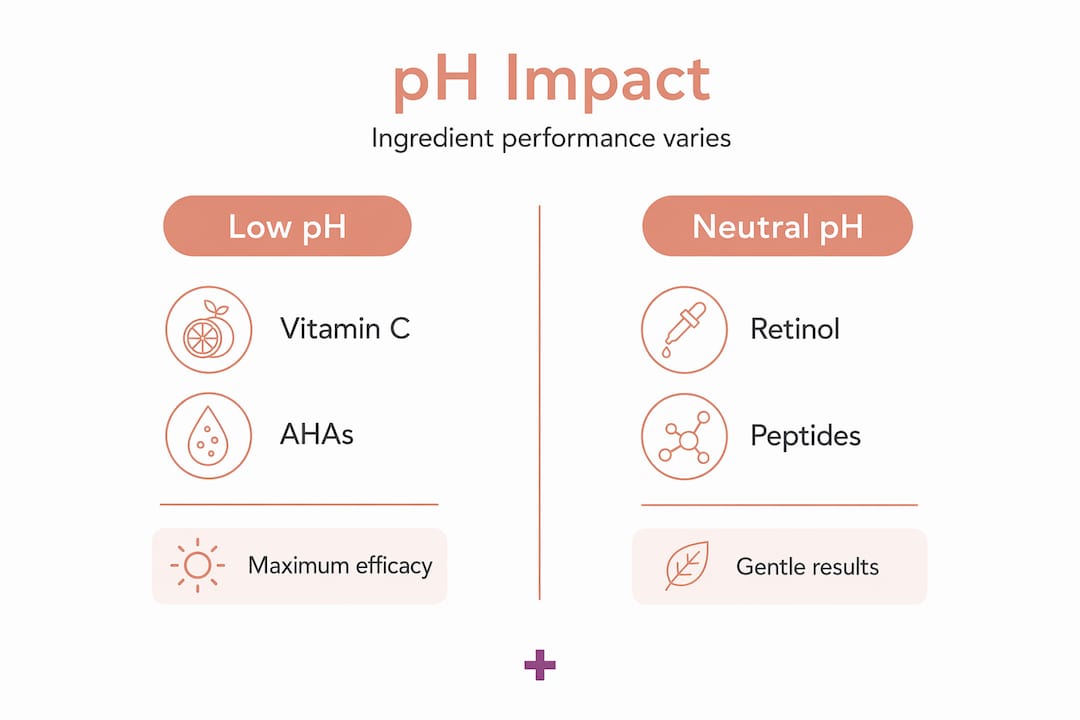
AHAs require an acidic pH between 3.5 and 4.5 for full efficacy. The reason is chemistry: the exfoliating power of glycolic or lactic acid depends on the acid being in its free, non-ionized form. Raise the pH and the acid ionizes, losing its ability to penetrate the skin and loosen the bonds between dead skin cells. A product marketed as a glycolic toner but formulated at pH 6 is essentially inactive as an exfoliant.

Vitamin C behaves similarly. L-ascorbic acid is highly unstable and oxidizes quickly above pH 3.5, turning the formula ineffective and often orange. This is why different product categories require pH formulations ranging from acidic to neutral depending on ingredient requirements.
Retinol and peptides are worth mentioning here too. Retinol functions best in slightly acidic to neutral conditions, and mixing it with highly acidic products in the same step can cause irritation without adding benefit. Peptides, on the other hand, tend to degrade in very acidic environments, which is why pairing a peptide serum directly with a pH 3 exfoliant isn’t a smart move.
Pro Tip: The pH listed on a product label may not match what you experience on your skin. pH on packaging can differ from real skin effects due to dilution, skin’s own buffering capacity, and how the formula interacts with sebum. This is why consistent routine use matters more than chasing a specific number.
Choosing pH-appropriate products for your skin
Understanding the importance of pH in skincare is one thing. Applying that knowledge when you’re standing in front of a shelf of products is another. Here’s a practical framework for making pH-conscious choices without needing a chemistry degree.
Start with your cleanser. The cleanser sets the foundation because it touches your skin first and affects its pH before anything else lands on it. Look for gel or cream cleansers labeled “pH-balanced” and avoid anything that lathers aggressively or leaves your skin feeling tight. Products balanced to around pH 5.5 minimize irritation and support natural healing.
Check exfoliant concentration and pH together. A 10% glycolic acid formula at pH 4 is far more potent than a 20% formula at pH 6. Concentration alone doesn’t tell you what you’re getting. If a brand doesn’t publish pH, that’s useful information about their transparency.
Give actives time to absorb before layering. After applying a low-pH serum like Vitamin C or an AHA, wait two to three minutes before applying the next product. This lets the formula interact with your skin properly before the pH shifts from the next layer.
Watch for warning signs. If your skin feels tight after cleansing, looks dull, reacts to products it used to tolerate, or breaks out in patches, your skin barrier may already be compromised. These are signals that your routine’s pH balance needs attention.
Be cautious with sensitive or compromised skin. Sensitive skin and skin conditions like eczema or rosacea are especially vulnerable to pH disruption. Stick to products at or near pH 5 to 5.5 and avoid combining multiple acidic actives in a single routine.
Pro Tip: You don’t need a pH meter to build a pH-smart routine. Knowing the category of each product you use and where it typically sits on the scale is enough to make informed decisions about layering order and product pairing.
My take on pH: the detail most routines overlook
I’ve spent a long time reading ingredient labels and testing products, and pH is consistently the factor that gets skipped over. People obsess over whether a serum contains 15% or 20% Vitamin C, but almost no one asks what pH that serum is formulated at. That’s backwards.
In my experience, skin that isn’t responding to a routine has a pH problem more often than an ingredient problem. A client switches from a foaming cleanser to a low-pH gel formula and suddenly finds that the rest of their routine starts working. Nothing else changed. But the cleanser was disrupting the acid mantle every morning, and everything applied after it was working against a compromised baseline.
What frustrates me most is how little transparency exists in skincare marketing. Brands list every botanical extract and percentage, but rarely publish pH values. Consumers deserve that information. It directly affects whether the product does what it claims to do. Advocating for clearer pH labeling isn’t niche knowledge. It should be standard practice.
The practical advice I’d give anyone is this: build your pH-aware skincare routine from the cleanser outward, pay attention to how your skin feels in the 10 minutes after washing it, and treat tightness or sensitivity as data rather than inconvenience.
— Kelly
Build a pH-conscious routine with Yukaface

Yukaface formulates every product with the skin’s natural pH balance in mind, using vegan, botanically sourced ingredients that work with your skin chemistry rather than against it. Whether you’re refining your morning skincare routine or exploring how actives like retinol and bakuchiol behave at different pH levels, the Yukaface journal covers the science in plain language. Yukaface products are crafted for all skin types and ages, with formulation transparency and skin compatibility at the core. Explore the full Yukaface journal for guides on skin barrier health, microbiome care, and building routines that genuinely support your skin long term.
FAQ
What is pH in skincare?
pH measures how acidic or alkaline a water-based skincare product is on a scale of 0 to 14, with 7 being neutral. It directly affects ingredient efficacy, skin barrier function, and microbiome health.
What is the best pH for a facial cleanser?
The best pH for a facial cleanser sits between 4.5 and 6.5, close to the skin’s natural range. Cleansers above pH 7 disrupt the acid mantle and can cause dryness and irritation over time.
How does pH affect skin barrier function?
When product pH is too high or too low relative to the skin’s natural range, it impairs enzyme activity, weakens lipid structure in the stratum corneum, and increases water loss. Repeated disruption leads to barrier damage.
Why do AHAs and Vitamin C need low pH?
AHAs must be in their free acid form, which only occurs below pH 4.5, to exfoliate effectively. Vitamin C (L-ascorbic acid) oxidizes and becomes unstable above pH 3.5, making pH control critical for both ingredients.
How can I tell if my routine is disrupting my skin’s pH balance?
Tightness after cleansing, increased sensitivity, sudden breakouts, and a dull or flaky texture are common signs. These often point to a compromised skin barrier caused by products that are too alkaline for regular use.