
Why Choose Organic Skincare: Benefits and Real Results
TL;DR:
The term “organic skincare” is regulated with strict standards, unlike the vague marketing of “natural” products. Choosing certified organic formulations reduces exposure to synthetic chemicals, supports environmental sustainability, and benefits sensitive skin. Verifying third-party certifications ensures authenticity, helping consumers make informed and responsible skincare choices.
Most people assume “natural” and “organic” mean the same thing on a product label. They don’t. And that gap in understanding is where a lot of bad purchasing decisions happen. If you’re researching why choose organic skincare, you’re already asking the right question. The organic skincare market is valued at USD 11.33 billion in 2024, projected to reach USD 24.4 billion by 2033. That growth isn’t just trend-chasing. It reflects a real, documented shift toward ingredient transparency, reduced chemical exposure, and environmentally responsible beauty choices.
Table of Contents
Why choose organic skincare: what it actually means
Before deciding whether organic skincare is right for you, it helps to understand what the label actually guarantees. Organic skincare refers to products formulated with ingredients grown without synthetic pesticides, herbicides, or fertilizers. The farming and sourcing process follows regulated standards, not just brand marketing language.
Here’s where it gets specific. Three certifications carry real weight in the industry:
USDA Organic: Requires at least 95% certified organic ingredients. Common in North American markets.
COSMOS (Cosmetic Organic and Natural Standard): A European standard that restricts prohibited substances and sets minimum organic content thresholds. It also regulates manufacturing processes.
ECOCERT: One of the oldest organic certification bodies, with specific rules on natural and organic ingredient percentages, biodegradable formulas, and eco-friendly packaging.
The key difference between organic, natural, and conventional skincare comes down to regulation.
CategoryIngredient StandardCertification RequiredSynthetic ChemicalsOrganicGrown without synthetic inputsYes (USDA, COSMOS, ECOCERT)Prohibited or tightly restrictedNaturalDerived from nature, loosely definedNoSometimes includedConventionalNo restrictionNoFreely used
“Natural” is a marketing term with no legal definition in most countries. A product can call itself natural while still containing synthetic preservatives, artificial fragrances, or petrochemical derivatives. Organic certification removes that ambiguity.
Skin health benefits of organic skincare
The clearest reason to select natural skincare over conventional alternatives comes down to what you’re putting on your skin daily and what those ingredients do over time.
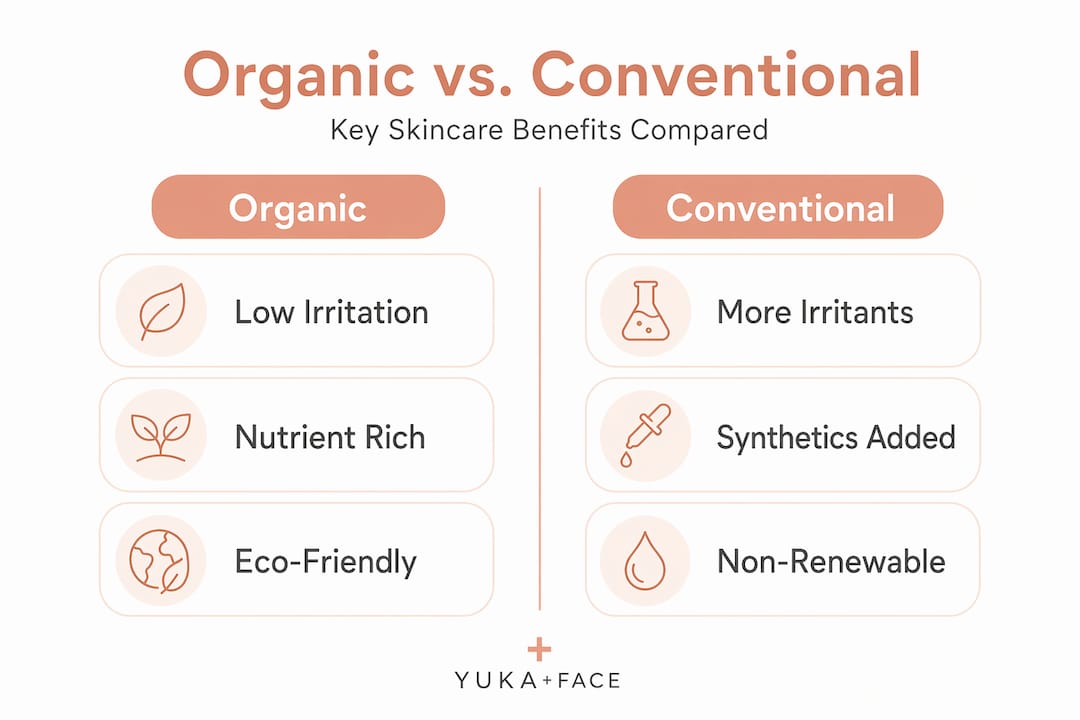
Conventional skincare often relies on parabens, sulfates, and synthetic fragrances to extend shelf life, create foam, or add scent. These ingredients are functional, but they come with trade-offs. Botanical ingredients in organic formulations provide antioxidants and vitamins that nourish skin while avoiding the irritation risk linked to harsh synthetic chemicals. For people with sensitive, reactive, or eczema-prone skin, that distinction is meaningful.
Here is what organic skincare formulations typically deliver for skin health:
No parabens or sulfates. These synthetic compounds appear in most conventional products. Parabens act as preservatives. Sulfates create lather. Both are linked to skin sensitivity and long-term irritation in susceptible individuals.
No synthetic fragrances. Artificial fragrance is one of the most common causes of contact dermatitis. Organic products use essential oils or remain fragrance-free, which reduces allergenic exposure.
Antioxidant-rich botanicals. Ingredients like green tea extract deliver polyphenols that protect against oxidative stress, a key factor in premature skin aging.
Vitamins and minerals from plant sources. Vitamin C from rosehip, vitamin E from sunflower oil, and zinc from plant sources all support collagen production and skin barrier function.
Better tolerability for sensitive skin. Natural herbal formulations show better tolerability and sustained therapeutic action compared to synthetic alternatives, particularly for barrier protection and hydration.
Organic skincare for sensitive skin is especially relevant because reactive skin types respond poorly to the layered synthetic load in conventional products. Stripping that out often produces noticeable improvement in redness, flaking, and tightness.
Pro Tip: When switching to organic skincare, introduce one product at a time over two to three weeks. This lets you track your skin’s response to each new formula without overwhelming your barrier.
The advantages of organic beauty go beyond just what is absent from the formula. Effective organic products balance natural actives with research-backed safety assessments to reduce allergenic risks and improve skin barrier health. That balance is what separates a quality organic formulation from one that simply lacks synthetic ingredients.
Environmental and ethical advantages
Choosing organic skincare is not only a decision about your skin. It’s a decision about what kind of supply chain you want to support. The environmental and ethical advantages of organic beauty extend from farm to packaging.
Reduced chemical pollution. Conventional agricultural runoff from synthetic pesticides and fertilizers contaminates soil and waterways. Organic farming eliminates this at the source, protecting local ecosystems and water quality.
Biodiversity support. Organic farms do not use broad-spectrum pesticides that kill beneficial insects, birds, and soil organisms. Supporting organic ingredient sourcing means supporting healthier ecosystems.
Sustainable soil management. Organic farming practices build soil health over time rather than depleting it. Healthy soil retains more water and sequesters more carbon.
Ethical sourcing and fair trade. Many certified organic skincare brands work with fair trade suppliers, paying fair wages to farmers and harvesters in developing regions where botanical ingredients originate.
Eco-conscious packaging. Organic skincare production increasingly pairs biodegradable formulas with recyclable or compostable packaging, reducing plastic waste at the consumer level.
Consumers who buy organic skincare are supporting sustainable supply chains and biodiversity preservation, not just making a personal health choice. The purchase decision has a downstream effect on farming communities and ecosystems. That’s a meaningful distinction from buying a conventional product with no ingredient or sourcing transparency.
Yukaface approaches this directly. Every product in the Yukaface range is cruelty-free, vegan, and built on botanically sourced ingredients. The brand’s commitment to environmental responsibility isn’t a marketing claim. It’s built into the sourcing and formulation process. For a deeper look at how vegan and organic principles overlap, the Yukaface vegan skincare guide explains the philosophy in detail.
Common myths and real limitations
Organic skincare comes with legitimate advantages. It also comes with honest limitations, and understanding those makes you a smarter consumer.
The biggest myth: all organic products are automatically safe for every skin type. That’s not accurate. Essential oils, which appear frequently in organic formulations, are a common allergen. Citrus oils, lavender, and peppermint can cause reactions in sensitive individuals even though they are entirely natural. “Organic” does not mean “hypoallergenic.”
Other important realities to understand:
Higher price points are real. Ethical farming, certifications, small-batch production, and sustainable packaging all add cost. You are paying for transparency and reduced environmental impact. That’s legitimate, but budget is a real factor.
Greenwashing is widespread. Many brands use terms like “green,” “clean,” “pure,” or “botanical” with no certification behind them. These labels mean nothing without third-party verification.
Shorter shelf life. Organic products without synthetic preservatives often have shorter shelf lives. Check expiration dates and store products correctly.
Efficacy varies by formulation. Not every organic product performs equally. Ingredient concentration, formulation pH, and delivery systems all affect results, the same as with conventional skincare.
Pro Tip: Before buying, search the brand name alongside “USDA Organic,” “COSMOS,” or “ECOCERT” to confirm actual certification. Don’t rely on packaging language alone.
Verification through third-party certifications is the most reliable way to confirm a product’s organic authenticity. If the certification isn’t listed or isn’t verifiable on the certifying body’s website, treat the organic claim with skepticism. The ingredient transparency trend reflects consumers getting better at asking these questions. That’s a good thing.
My take on choosing organic skincare
I’ve watched the organic skincare space grow from a niche category to a mainstream market, and with that growth came both genuine progress and a lot of noise. Here’s what I’ve actually learned from following this space closely.
Most people start asking about organic skincare after a negative experience with conventional products. Breakouts, persistent redness, or a product that worked for everyone else but not for them. In my experience, this is almost always the right question to ask, but people often land on the wrong answer. They switch to “natural” products without checking for certifications and end up with something equally problematic, just with better packaging.
What I’ve found is that the real value of organic skincare isn’t in any single ingredient. It’s in the cumulative reduction of synthetic chemical load on your skin over months and years. Your skin is your largest organ, and what you apply daily matters in ways that a single patch test won’t reveal.
I also think the environmental case is underrated. Most skincare consumers focus on skin results and treat the eco-friendly angle as a bonus. Flip that thinking. If a product works reasonably well AND supports ethical sourcing and cleaner production, that’s worth paying a premium for. The alternative is cheaper in the short term and more costly in ways that don’t show up on your receipt.
The pitfall I see most often is choosing organic based on marketing aesthetics rather than ingredient lists and certifications. Minimalist packaging and botanical imagery are not proof of anything. Slow down. Read the label. If organic skincare ingredients and certifications are listed clearly, that’s a brand worth trusting.
— Kelly
Explore organic skincare with Yukaface

Yukaface builds every product on the same foundation: botanical research, vegan ingredients, and formulations designed for all skin types and ages. If this article helped clarify the benefits of organic skincare for you, the next step is putting that knowledge into a practical routine.
Start with the Yukaface vegan skincare guide for a clear overview of how organic and vegan principles work together in a daily routine. For morning routine specifics, the Yukaface morning skincare routine walks through hydration and protection steps that pair well with organic formulations. And if you’re curious about the ingredient side of things, the Yukaface journal covers everything from green tea antioxidants to peptides in organic skincare with the same commitment to transparency and science that goes into every product.
FAQ
What does “organic skincare” actually mean?
Organic skincare refers to products formulated with ingredients grown without synthetic pesticides or fertilizers, verified through certifications like USDA Organic or COSMOS. Unlike “natural,” organic is a regulated term with defined standards.
Is organic skincare better for sensitive skin?
Organic skincare for sensitive skin reduces exposure to common irritants like synthetic fragrances, parabens, and sulfates, which lowers the risk of contact dermatitis and chronic irritation. That said, some natural ingredients like essential oils can still cause reactions.
Why does organic skincare cost more?
The higher price reflects real costs: ethical farming, third-party certification, small-batch production, and sustainable packaging. Consumers pay for ingredient transparency and reduced environmental impact, not brand luxury alone.
How do I spot greenwashing in skincare?
Look for third-party certifications (USDA Organic, COSMOS, ECOCERT) and verify them on the certifying body’s official website. Terms like “green,” “pure,” or “botanical” on packaging carry no regulatory weight without certification to back them up.
Can organic skincare replace conventional skincare completely?
For most people, yes. Certified organic products cover cleansing, moisturizing, treating, and protecting. Efficacy depends on formulation quality, not whether a product is organic or conventional. Start with one product category and assess results before making a full switch.