
How to personalize skincare routine for your unique skin
TL;DR:
Generic skincare products often do not meet individual needs and can cause irritation or breakouts. Personalizing routines involves assessing skin type, concerns, sensitivities, lifestyle, and using minimal, targeted products that work harmoniously with one’s skin. An effective routine emphasizes correct product selection, gradual introduction of actives, and ongoing adjustment based on changing skin conditions.
Generic skincare products fail more people than they help. If you have sensitive, combination, or aging skin, you already know this firsthand: the wrong cleanser strips your moisture barrier, the wrong serum triggers a flare, and the “universal” moisturizer clogs your pores. Learning how to personalize skincare routine steps around your actual skin needs, not a marketing demographic, changes everything. This guide walks you through assessing your skin, building a tailored daily routine with natural and cruelty-free products, and avoiding the most common personalization mistakes that keep people stuck in trial-and-error cycles.
Table of Contents
Understanding your skin type and concerns
The foundation of any personalized skincare routine is honest self-assessment. Not the kind that takes 60 seconds on a brand quiz, but a real look at what your skin does day to day and what your life asks of it.
The four main skin types and what they signal:
Dry skin: Feels tight after cleansing, flakes at the corners of the nose or cheeks, and reacts badly to alcohol-based products
Oily skin: Visibly shiny within a few hours of cleansing, prone to enlarged pores and congestion, and often responds well to lighter, water-based formulas
Combination skin: Oily through the T-zone (forehead, nose, chin) but dry or normal on the cheeks; needs zone-specific care more than a single product fix
Sensitive skin: Reacts with redness, stinging, or breakouts to new products; often overlaps with conditions like rosacea, eczema, or contact dermatitis
Beyond skin type, your specific concerns matter just as much: active acne, post-inflammatory hyperpigmentation, fine lines, dehydration, or rosacea. Each one points toward different actives and textures. Personalized routines are built from an assessment that captures your skin concerns, goals, sensitivities, and medical history, avoiding unnecessary irritating ingredients.
Lifestyle factors are equally critical. High sun exposure, a physically demanding job, air travel, smoking history, or current medications all influence which actives your skin can tolerate and which will backfire. For example, if you are on photosensitizing medication, acids and retinoids carry more risk without diligent SPF use. If you are in a dry climate, even oily skin may need more barrier support than you expect.

Assessment factorWhy it mattersWhat to considerSkin typeDetermines base product texturesOily, dry, combination, sensitiveSkin concernsGuides active ingredient selectionAcne, aging, rosacea, pigmentationSensitivities/allergiesPrevents irritation and reactionsFragrance, nuts, specific activesMedical historyIdentifies contraindicated ingredientsMedications, conditions like eczemaLifestyle/environmentAdjusts protection and hydration needsUV exposure, climate, stress levels
For deeper insight, advanced skin assessments performed by dermatologists or aestheticians use tools like skin analyzers, patch testing panels, and photo analysis to map your skin more precisely than any at-home quiz.
Pro Tip: Start with the fewest products possible. Introduce one new product every two weeks so you can clearly track what your skin responds to, positively or negatively. If you add three products at once and develop irritation, you have no way to identify the cause.
Getting the assessment right is the most important step in building a skincare routine that actually holds up over time.
Building your customized routine step-by-step
With a clear understanding of your skin, building your daily routine becomes a much simpler process. The goal is not to own more products. It is to own the right ones for your specific biology.
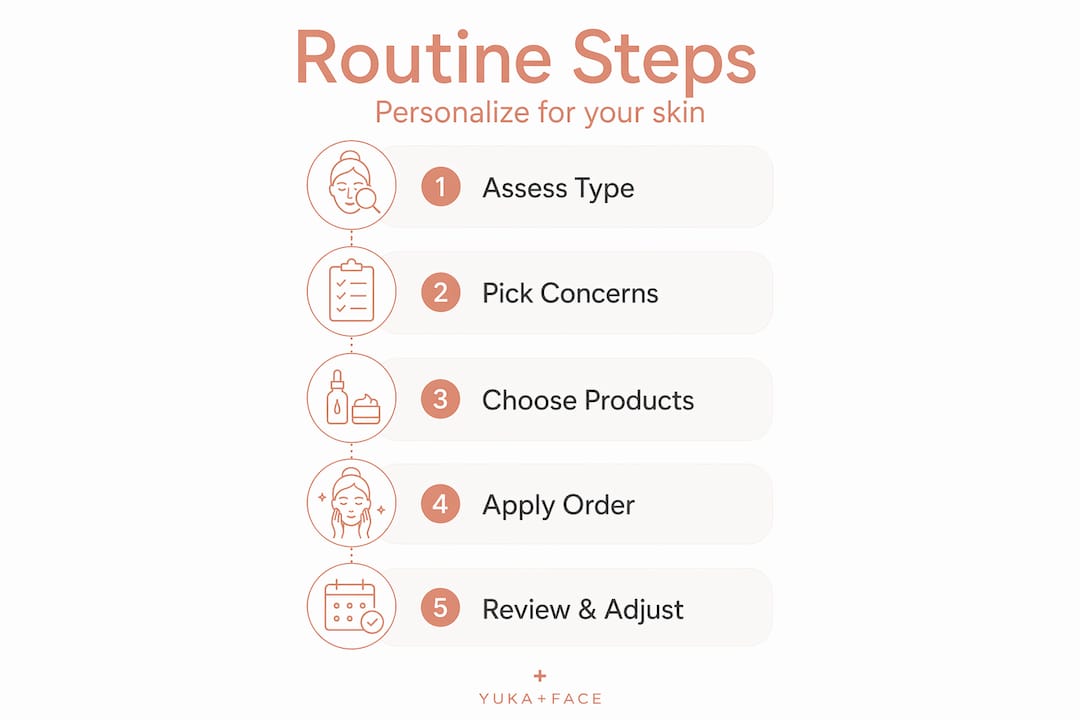
A dermatologist-simplified skincare approach confirms that a truly effective minimal routine consists of only three steps: cleanse, treat, and protect, with broad-spectrum SPF 30+ mineral sunscreen as the non-negotiable final step for sensitive skin.
Step-by-step routine framework:
Cleanse: Match your cleanser to your skin type. Cream or milk cleansers work for dry and sensitive skin because they do not strip the lipid barrier. Gel or foam cleansers suit oily or acne-prone skin. Micellar water works well for sensitive skin as a gentle first cleanse. Avoid anything with sodium lauryl sulfate (SLS) if your skin reacts easily.
Treat: This is where actives do the heavy lifting. Choose based on your primary concern. Vitamin C (L-ascorbic acid, 10 to 20%) targets brightening and antioxidant protection. Retinoids, including retinol and prescription tretinoin, address anti-aging and acne but require gradual introduction. Azelaic acid is a standout for rosacea, mild acne, and pregnancy-safe brightening. Niacinamide (5 to 10%) suits almost everyone for barrier support and redness reduction.
Moisturize: Every skin type needs moisture, even oily skin. For sensitive or rosacea-prone skin, ceramide-rich formulas help repair and maintain the barrier. For oily skin, a lightweight gel-cream with hyaluronic acid adds hydration without occlusion. Dry skin benefits from richer formulas containing shea butter, squalane, or natural plant oils.
Protect: Mineral sunscreen for sensitive skin should be a broad-spectrum SPF 30 or higher containing zinc oxide or titanium dioxide. These physical filters sit on top of the skin and deflect UV rather than absorbing it, making them far less likely to trigger reactions than chemical filters. Apply every morning, regardless of the season or your plans.
Active ingredient comparison by skin type and concern:
ConcernOily/Acne-proneDry/MatureSensitive/RosaceaPregnancyAcneBenzoyl peroxide, retinoidRetinol (low %), salicylic acidAzelaic acid, niacinamideAzelaic acid, topical erythromycinAnti-agingRetinoid, niacinamideRetinol, peptides, vitamin CPeptides, azelaic acidPeptides, vitamin C (L-AA)BrighteningVitamin C, niacinamideVitamin C, alpha-arbutinAzelaic acid, niacinamideAzelaic acid, niacinamideHydrationHyaluronic acid, niacinamideCeramides, hyaluronic acidCeramides, panthenolCeramides, hyaluronic acid
Check the morning skincare routine guide for timing and layering specifics by product type. For age-specific ingredient adjustments, skincare by age provides decade-by-decade guidance on what to add and when.
Pro Tip: Always layer from thinnest to thickest consistency: cleanser, toner (if used), serum, moisturizer, then sunscreen. Introduce any new active at the lowest available concentration first, use it two to three times per week, and increase frequency only once your skin shows no reaction after four weeks.
Special considerations: Acne, pregnancy, and aging
Certain life stages and skin conditions change the personalization rules significantly. Using a general routine during pregnancy or for active moderate-to-severe acne can do more harm than good.
Acne: Treatment is evidence-based and stepwise, moving from topical benzoyl peroxide and retinoids, with or without topical antibiotics, up to oral therapies for moderate to severe cases. Personalizing an acne routine means identifying whether your acne is hormonal, comedonal, inflammatory, or cystic. Each type responds to different actives, and stacking multiple harsh treatments accelerates irritation without improving results.
Pregnancy: Retinoids must be avoided during pregnancy due to potential fetal risk. Safer alternatives during this stage include bakuchiol, niacinamide, azelaic acid, gentle alpha-hydroxy acids at low concentrations, and consistent mineral sunscreen use. High-dose salicylic acid and hydroquinone are also on the avoid list. The goal during pregnancy is gentle maintenance, not aggressive treatment.
Aging skin: Skincare by age follows a clear progression. In your 20s, focus on cleansing, hydration, and sun protection. In your 30s, add vitamin C and peptides for collagen support. In your 40s and beyond, shift toward richer barrier support, retinoids (if not pregnant or nursing), and ingredients that address skin thinning and moisture loss. The aging skincare tips approach at Yuka+Face centers on antioxidants and botanical actives that work with aging skin rather than against it.
Key adjustments by condition:
Hormonal acne benefits from niacinamide and azelaic acid, not just benzoyl peroxide
Rosacea flares can worsen with common acne treatments; always confirm the diagnosis first
Mature skin loses its ability to retain water, making occlusive moisturizers more important than they were in younger years
For men, thicker skin and regular shaving require specific barrier repair after each shave. The vegan men’s skincare guide covers this in detail.
Pro Tip: Any time your skin type or condition changes, whether from pregnancy, a new medication, seasonal shifts, or age, treat it as a new starting point. Patch test even products you have used before, because your tolerance may have shifted.
Common mistakes and troubleshooting your personalized routine
Building a routine is one thing. Maintaining it without sabotaging it is another. Most personalization fails not from choosing wrong products, but from misusing them.
The most common mistakes:
Overloading the routine: Using six or more products daily increases the risk of ingredient conflicts and skin irritation without adding proportional benefit. More steps do not equal better skin.
Using strong actives too soon: Irritation from strong actives is one of the most common reasons routines fail. Retinoids, high-concentration vitamin C, and AHAs/BHAs need a slow introduction, not daily use from day one.
Misdiagnosing skin conditions: Treating rosacea with acne products, for example, will usually make the redness and sensitivity worse. If your skin does not respond to a well-chosen routine within six to eight weeks, consider whether your diagnosis is accurate.
Skipping patch tests: This step takes 48 to 72 hours and can save you weeks of recovery from a full-face reaction.
Changing products too frequently: Skin needs four to six weeks to show a realistic response to any new product or routine change. Switching sooner means you never actually know what worked.
Important: If you experience swelling, severe redness, hives, or difficulty breathing after applying any skincare product, stop use immediately and contact a healthcare provider. These signs may indicate an allergic reaction that requires medical attention, not just product discontinuation.
Pro Tip: Keep a simple skin journal for the first six weeks of any new routine. Note what you applied, when, and how your skin looked and felt the next morning. Patterns become visible quickly, and adjustments become data-driven rather than guesswork.
If irritation or breakouts persist after careful troubleshooting, revisit the building skincare routines guide or consult a dermatologist before adding more actives.
The overlooked art of true skincare personalization
Here is what most personalization guides do not say outright: the majority of “personalized skincare” services on the market are not actually personalized. They are segmented. A short quiz that places you into one of five skin type buckets and recommends a preset product set is not personalization. It is slightly more targeted mass marketing.
True personalization, as the evidence shows, requires assessment of sensitivities, lifestyle exposures, and medical history. Without that depth, personalization degrades into exactly the kind of marketing-led product stacking that causes more reactions than it solves.
“Personalized skincare that accounts for lifestyle, environment, and medical context reduces unnecessary ingredient exposure, improves tolerance, and produces better long-term results than any one-size-fits-most approach.” Personalized Skincare Routine Guide, MD Body & Med Spa
The most effective personalized routines we have seen share one characteristic: they are minimal. Three to four products, well chosen, consistently used. The idea that more products equal better results is a retail myth. Your skin’s barrier can only absorb and respond to so much at once.
Holistic and cruelty-free products fit naturally into this approach, not just for ethical reasons, but practical ones. Formulas free from synthetic fragrance, parabens, and harsh sulfates carry a lower baseline irritation risk, which matters enormously for sensitive skin. When you are already managing rosacea or a compromised barrier, every unnecessary ingredient is a variable you do not need.
Personalization also requires ongoing adjustment. The routine that works at 32 needs updating at 45. What suits your skin in winter may not work in summer. A truly tailored approach to building a skincare routine is not a one-time event. It is a practice.
Explore vegan, natural skincare tailored just for you
Now that you understand how to personalize your skincare routine, the next step is finding products that match your skin, your values, and your goals. Yuka+Face offers a range of 100% natural, vegan, and cruelty-free products formulated with botanical actives for all skin types and ages. Every formula is designed to work with your skin’s biology, not against it.
Explore the guide to vegan skincare to understand what cruelty-free formulation means for ingredient quality and skin compatibility. Ready to build your routine from scratch? The building a customized skincare routine resource walks you through each step with Yuka+Face products in mind. For morning-specific guidance, the morning skin care routine tips page covers layering, timing, and SPF integration to help your routine deliver the most protection and results every day.
Frequently asked questions
How do I determine my skin type for personalization?
Observe how your skin feels and looks two to three hours after cleansing, without applying any products. Personalized routines begin with assessments evaluating skin type, concerns, and sensitivities, so a dermatologist or licensed aesthetician can provide a more precise reading if self-assessment feels unclear.
Can I use retinoids during pregnancy for anti-aging?
No. Clinicians advise avoiding retinoids during pregnancy due to safety risks; niacinamide, azelaic acid, and consistent mineral sunscreen are the recommended alternatives for managing skin concerns during this stage.
What is the safest sunscreen for sensitive skin?
Broad-spectrum mineral sunscreens with zinc oxide or titanium dioxide at SPF 30 or higher are the best-tolerated option for sensitive or rosacea-prone skin. SPF 30+ mineral sunscreens are the standard recommendation from dermatology-aligned sources for reactive skin types.
How many products should a personalized skincare routine include?
Three is a strong target: cleanse, treat, and protect. Simplified skincare advice consistently points to this structure as the most effective for skin health and barrier integrity, with minimal risk of ingredient conflict or overload.
Why is patch testing important when personalizing skincare?
Patch testing identifies how your skin reacts to a specific ingredient before it touches your entire face. Patch testing new products for 48 to 72 hours is the standard recommendation, especially for sensitive skin or anyone introducing an unfamiliar active for the first time.